Master of Medical Science in Physician Assistant Studies, Glendale Campus
Midwestern University's PA Program offers accredited, student-centered training to become a valued member of an interprofessional healthcare team, focusing on evidence-based medicine and compassionate decision-making for diverse patient populations.
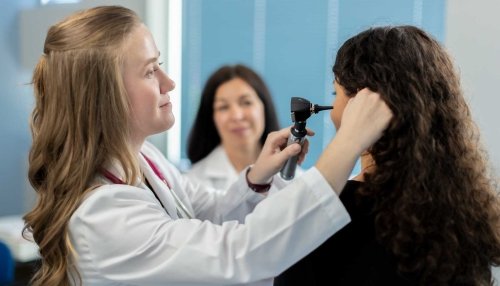
The 24-month full-time program leads to a Master of Medical Science in Physician Assistant Studies (M.M.S.) and prepares students for the Physician Assistant National Certifying Examination (PANCE). Graduates gain diverse clinical skills, including patient assessment, diagnostics, therapeutic modalities, minor surgery, emergency care, health promotion, and interpersonal skills through a blend of didactic and clinical education.
Interprofessional Focus
The Physician Assistant Program places a strong emphasis on interprofessional collaboration. As future healthcare providers, our students are encouraged to work seamlessly within multidisciplinary teams, fostering a holistic approach to patient care.
Curriculum Highlights
Our comprehensive curriculum covers a diverse range of medical disciplines, including basic sciences and clinical preparatory coursework during the initial 12 months, followed by seven required core clinical rotations and one elective rotation. These rotations take place in various healthcare settings, both urban and rural, including hospitals, community health centers, and more, offering students comprehensive experience in preparation for their career as Physician Assistants. You'll explore fields like Emergency Medicine, Family Medicine, Internal Medicine, Behavioral Medicine, Surgery, Pediatrics, Women's Health, plus one elective.
Clinical Experience
The second-year clinical program offers diverse experiences in various healthcare settings, representing the wide range of Physician Assistant career opportunities. From urban to rural, our affiliated sites include medical practices, hospitals, and government facilities. We also have affiliations in multiple states, expanding your network. Students are expected to secure their own housing for rotations, and must provide their own transportation to all core and elective clinical rotations regardless of location.
Ready for Practice
Midwestern University Physician Assistant Program graduates possess the skills to embark on diverse career paths, confidently conducting patient assessments, interpreting diagnostic studies, selecting treatment modalities, managing emergencies, promoting health through education, and demonstrating essential interpersonal skills.
Learn More
Learn more about program requirements and find quick links to relevant catalog content. You’ll also find information on WICHE PSEP tuition assistance and scholarships to guide you in your application process.
- Bachelor's degree from a regionally accredited college or university
- Minimum cumulative and science GPA of 3.00 on a 4.00 scale
- Successful completion of prerequisite coursework from regionally accredited colleges or universities
- Healthcare experience strongly preferred
Full list of requirements in catalog*
*Subject to change
Admissions Procedures
The program adheres to a specific admission process, and prospective students are encouraged to become acquainted with our interview and selection procedures.
Advanced Placement
Midwestern University's Physician Assistant (PA) Program does not permit advanced placement for prior academic, clinical, or life experience. Requests may be made for advanced placement for coursework and will only be considered if a letter grade of "C" or better has been earned and must be deemed equivalent to the Midwestern University course.
Extended Program
The PA Program does not offer an extended course of study beyond the usual length of the program.
Student Work Policy
Due to the rigorous time demands during the didactic and clinical years, the PA Program strongly discourages students who are enrolled in the Program from working outside of school during the 24-month Program.
Some students may be able to successfully coordinate campus work-study jobs, but the educational requirements of the Program remain the priority. Students who do choose to work at off-campus jobs despite this recommendation are expected to maintain all university and Program attendance expectations, professionalism, and academic standards.
Students should consult with a counselor in the Office of Student Financial Services if they are in need of more financial resources. Students who are in the work-study Program for Midwestern University may not conduct their work in the PA Program offices due to confidentiality concerns with student records. PA students may utilize the work-study Program, as outlined by federal guidelines, for community service projects. PA students are NOT required to work for the program.
Student Rotations
The PA Program does not require prospective or enrolled students to provide or solicit clinical sites or preceptors. Students may, with approval, arrange rotations both within and outside of Arizona.
Full list of requirements in catalog*
*Subject to change
Agreement with Aurora University
Beginning with the class matriculating in Fall 2023, Midwestern University’s participating colleges and programs agree to guarantee interviews for qualified Aurora University applicants as long as specific requirements are met.
Review the Articulation Agreement with Aurora University
Agreement between Midwestern University Programs
In addition, currently-enrolled Midwestern University students are eligible to use the Articulation Agreement Between Midwestern University Programs. This agreement allows for students enrolled in a Midwestern University program to receive an admissions interview with another University program as long as specific requirements are met.
Review the Articulation Agreement Between Midwestern University Programs
Agreement with Grand Canyon University
Beginning with the class matriculating in summer quarter 2027, the Midwestern University Physician Assistant Program in Glendale, AZ agrees to guarantee an interview for one qualified Grand Canyon University applicant per admission year.
Review the Articulation Agreement with Grand Canyon University
Core Competencies for the Midwestern University Physician Assistant Program Arizona
To ensure students who graduate from the Midwestern University- Physician Assistant (PA) Program are prepared for entry-level PA practice, they receive a didactic and clinical training curriculum that facilitates their achievement of specific core competencies. The PA Program competencies were developed using existing competency frameworks, such as the Competencies for the Physician Assistant Profession (revised 2020) and the Physician Assistant Education Association’s Core Competencies for New Physician Assistant Graduates.
Upon completion of the program, the student will achieve the following:
Knowledge for Practice; Interpersonal and Communication Skills; Person-centered Care
Learning Outcome 1: Integrate critical thinking skills with evidence-based medical knowledge and patient care to provide entry level primary health care services for a diverse population in a variety of settings.
1A: Understand basic scientific principles of anatomy, physiology, pathophysiology, and pharmacology necessary to practice medicine as a physician assistant.
1B: Assess the health status of individuals of all ages by obtaining a history and physical examination, recommending, and interpreting appropriate diagnostic studies, diagnosing, formulating appropriate differential diagnoses, and developing a management plan for primary care conditions.
1C: Apply principles of health promotion and disease prevention to provide primary health care across the lifespan.
1D: Recognize health disparities and social determinants of health in the delivery of patient care.
1E: Provide counseling, patient education, interventions, and appropriate referral for promotion, maintenance, and restoration of optimal levels of health for individuals of all ages.
1F: Refine interpersonal and communication skills and exercise cultural competence to ensure effective information exchange with patients, families, and members of the professional health care team.
Professionalism and Ethics; Interprofessional Collaboration
Learning Outcome 2: Develop professional accountability to patients, society and the profession, and a commitment to excellence, integrity, inclusivity, equity, and ongoing professional development.
2A: Demonstrate a high level of responsibility and ethical practice while acknowledging professional and personal limitations.
2B: Understand the importance of the team approach to health care and work closely with other health care professionals to develop trusting relationships and strong medical practice ethic.
2C: Recognize the importance of provider wellness and implement strategies to mitigate and prevent stress and burnout.
Practice-Based Learning and Quality Improvement
Learning Outcome 3: Engage in critical analysis of practice experience, medical literature, and informational resources for the enhancement of patient care outcomes and self-improvement.
3A: Gain a basic understanding of research methods, statistical analysis, and medical literature to improve comprehension of peer-reviewed studies the application of evidence-based information into clinical practice.
3B: Engage in self-reflective practice to identify opportunities for growth and develop a tailored self-directed learning and professional development plan.
3C: Incorporate constructive feedback in all professional endeavors.
Society and Population Health
Learning Outcome 4: Gain an understanding of the role of physician assistants to serve the societal, organizational, and economic environments as patient care advocates and role models for future physician assistant students and members of the health care team.
4A: Maintain awareness of and responsiveness to legal and ethical issues, equity and inclusion, patient safety and the larger system of health care to provide optimal value to patient care.
4B: Advance professional role identity and accountability as a primary care provider developing leadership skills, removing barriers to health, and responsibility to serve as physician assistant mentors within the profession.
Full list of requirements in catalog*
*Subject to change
Mission
The Midwestern University Physician Assistant (PA) Program on the Glendale campus is committed to educate and mentor students in a setting that cultivates excellence, and prepares compassionate, competent physician assistants to serve in a changing healthcare environment. We value a culture of inclusion where students, staff and faculty are honored, respected, and engaged.
The philosophy of the PA Program is based on a dedication to the student-centered approach to teaching and learning.
Goals
Program Goals are met through a variety of curricular objectives and assessments.
The Goals of the Midwestern University PA Program, Glendale Campus, include:
- Develop competent Physician Assistants
- Deliver a thorough and comprehensive curriculum that promotes inter-professional education, team-based practice, and service within the healthcare community
- Facilitate critical-thinking skills and evidence-based practices
- Mentor students and promote professionalism and inclusion
- Demonstrate a genuine commitment to program excellence through a process of continuous self-assessment and curricular improvements.
These goals are met in a variety of ways:
- The curriculum has contributed to an average first-time PANCE pass rate of 96% over the last five years (98%, 98%, 98%, 94%, and 93%, respectively). This is compared to the national average of 93%. 100% of new graduate respondents (Class of 2023) reported full-time employment. This is above the national average of 61% of newly certified PAs who accepted a clinical position (NCCPA 2023 Statistical Report).
- The curriculum provides a strong basis for clinical practice in the following ways:
- A rigorous basic science curriculum (anatomy, biochemistry, pharmacology, physiology, and microbiology) is delivered by content area experts and PA Program courses are taught by experienced PA faculty.
- The program promotes inter-professional, team-based education via a University-wide, interdisciplinary course involving all PA first-year students that develops teamwork and collaboration between the professions via didactic presentations, small group discussions, and activities.
- Faculty encourage and model service to the profession and to our community. This is evident by 20% of alumni are currently participating in the training of a MWU PA student as a preceptor; PA faculty involvement with state and national organizations (ASAPA, PAEA, AAPA, etc.). Additionally, 27% of the respondents of 2023 graduates report employment in health professions shortage areas or medically underserved communities.
- Students are required to complete a didactic course dedicated to the development of critical thinking skills and the application of evidence-based practices. The students then utilize these skills in interactive clinical case group discussions, simulation activities, clinical rotations, and assessments by faculty and preceptors throughout their training.
- Faculty encourage, model, and assess professionalism and inclusion. Health Professionalism, during the first quarter, is a course devoted to teaching professionalism (values and ideals as described in 'Competencies for the PA Profession') and the program has implemented a code of professional conduct and dress code. The course also includes lecture-based discussions and a the completion of modules including case studies highlighting social determinants of health. The Professional Development year-long series includes sessions on disparities in health care with case-based application along with didactic lectures dedicated to enhancing student success and in prevention of student and future clinician burnout. Upon matriculation, every student in the program is assigned a PA faculty mentor who monitors the student's professional and academic performance in the didactic and clinical phases of training. Additionally, students are evaluated by preceptors regularly throughout the clinical year on their professional conduct/demeanor, dependability/responsibility, educational attitude, and receptivity to feedback.
The program has a continuous process of self-assessment that allows for data collection and subsequent analysis throughout the curriculum. A variety of perspectives are formally sought in this process including those of students, faculty, clinical preceptors, and graduates in the form of regularly scheduled surveys and evaluations. This serves to further improve the experience for students and is foundational to maintaining accreditation.
View catalog for more information*
*Subject to change
National Certifying Exam (PANCE) Pass Rate 5-Year Average (2021-2025)
- Our students are at, or above, the national pass rate each year
- Five five-year average pass rate for first-time takers is 98% (national average is 95%)
For information pertaining to the Program's attrition and graduation rates, please review the ARC-PA Student Attrition Template.
ARC-PA Student Attrition Template (PDF)
Graduated Classes | |||
|---|---|---|---|
Class of | Class of | Class of | |
Maximum entering class size (as approved by ARC-PA) | 90 | 90 | 90 |
Entering class size | 95 | 93 | 91 |
Graduates | 89 | 91 | 91 |
*Attrition rate | 6.30% | 2.15% | 0% |
**Graduation rate | 93.7% | 97.8% | 100% |
*Attrition rate calculation: Number of students who attritted from cohort divided by the entering class size.
**Graduation rate: Number of cohort graduates divided by the entering class size.
Comments:
Students who took a short leave of absence for personal or medical reasons and completed their training were counted in the class in which they matriculated.
The attrition rate due to academic dismissal is 1% for the Classes of 2023, 0% for the Class of 2024 and 0% for Class of 2025.
- Female: 77%
- Male: 23%
- Mean Age: 25
- Mean Science GPA: 3.88
- Mean Overall GPA: 3.85
- 98% had a total GPA above 3.5
- Top Home States: Arizona (34%), California, Utah, Oregon
- Average paid healthcare hours ranged between 500-2000 hours with the majority of the matriculating class having > 2000 hours
Midwestern University’s Physician Assistant Studies, Glendale Campus is part of the Western Interstate Commission for Higher Education (WICHE) Professional Student Exchange Program (PSEP). PSEP allows students outside of Arizona who live in WICHE’s participating states and are pursuing careers in 10 health fields – ranging from optometry to dentistry to veterinary medicine – to apply for participating healthcare programs across state lines and receive substantial tuition support from their home state or territory. Visit the WICHE website for complete details about PSEP and how to apply for reduced tuition.
Visit our Scholarships page to explore other opportunities.
The Accreditation Review Commission on Education for the Physician Assistant, Inc. (ARC-PA) has granted Accreditation-Continued status to the Midwestern University Glendale Physician Assistant Program sponsored by Midwestern University. Accreditation-Continued is an accreditation status granted when a currently accredited program is in compliance with the ARC-PA Standards.
Accreditation remains in effect until the program closes or withdraws from the accreditation process or until accreditation is withdrawn for failure to comply with the Standards. The approximate date for the next validation review of the program by the ARC-PA will be June 2028. The program’s accreditation history can be viewed on the ARC-PA website.
Midwestern University is accredited by The Higher Learning Commission/A Commission of the North Central Association of Colleges and Schools (HLC/NCA), 230 South LaSalle Street, Suite 7-500, Chicago, IL 60604-1413.
Academic Course Catalog
Explore details regarding your specific College/Program (subject to change).
Hear Our Stories
Erin McCabe, M.M.S., Physician Assistant Studies, Class of 2025
"I also knew that Midwestern has this reputation of creating amazing providers that are ready to tackle healthcare and I think that I am receiving an amazing education."
Eve Hoover, D.M.Sc., PA-C, DFAAPA, Associate Professor, Physician Assistant Program
"The number one thing about Midwestern that I love is the students."

Manuel Pompa, M.M.S., Physician Assistant Studies, Class of 2020
"Being a Physician Assistant to me means that I'm able to contribute toward cutting that provider-patient gap."