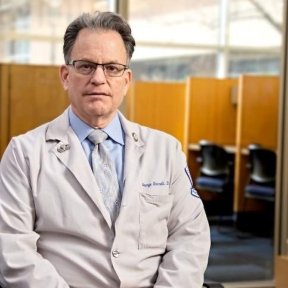
Doctor of Osteopathic Medicine (D.O.) Chicago College of Osteopathic Medicine
The Chicago College of Osteopathic Medicine (CCOM) seamlessly blends the art and science of medicine, offering modern patient-centered education with expert mentors, advanced technology, and hands-on experiences.
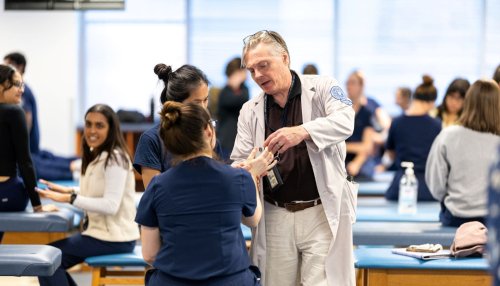
Established in 1900, CCOM's enduring reputation for excellence guarantees your inclusion in exceptional rotations, internships, and residencies with our esteemed clinical partners.
Philosophy of Osteopathic Medicine
Osteopathic physicians embrace a holistic philosophy that views the body as an integrated whole, recognizing the interdependence of structure and function. They prioritize individualized care, acknowledging patients' biological, psychological, and sociological needs.
CCOM’s Modern Approach
To adapt to the evolving landscape of osteopathic medicine in the 21st century, CCOM continuously refines its curriculum. This includes a progressive integration of basic and clinical sciences, upholding rigorous standards through interactive teaching methods that mirror the patient-centered approach of osteopathic physicians in clinical practice.
Clinical Experience
CCOM students have CORE clinical rotations in family medicine, internal medicine, surgery, pediatrics, psychiatry, osteopathic manipulative medicine, obstetrics/gynecology, and emergency medicine. In addition, they take a core selective rotation in a field of their interest, as well as numerous electives and audition rotations their senior year.
Ready for Practice
Upon graduation with the D.O. degree, graduates have the skills and experience needed to provide excellent patient care and are eligible for postdoctoral residency training in all fields of medicine.
Why Our Program is Exceptional
- Our Location: We are a small, safe campus, located close to many reputable hospitals in Chicago.
- Our Reputation: Our rotation experience is unmatched, and our board pass rates are above the national average.
- Our Faculty: Our faculty prioritize personalized, one-on-one attention with students.
- What We Care About: We love emphasizing the importance of bedside manner, communication, and forming relationships with patients and their families.
- What Sets Us Apart: We offer a state-of-the-art Simulation Center and research training opportunities.
Learn More
Learn more about the requirements and find quick links to relevant catalog content to guide you in your application process.
- Bachelor's degree
- Minimum total and science GPA of 2.75
- MCAT scores
- Two letters of recommendation
CCOM considers those students for admission who possess the academic, professional, and personal qualities necessary to become exemplary osteopathic physicians. To select these students, the College uses a rolling admissions process within a competitive admissions framework.
Students seeking admission to CCOM must submit the following documented evidence:
- Completion of the admissions course requirements
- Grades of C or better (grades of C- are not acceptable)
- To be competitive, students should have minimum cumulative and science GPAs over 3.00 on a 4.00 scale
- To receive a supplemental application, students must have minimum cumulative and science GPAs of 2.75 on a 4.00 scale
- Completion of a bachelor's degree from a regionally accredited college or university prior to matriculation
- Competitive test scores on the Medical College Admissions Test (MCAT)
- Average MCAT score for students entering CCOM in 2025 was 509
Only MCAT exam scores earned from tests taken no more than 3 years prior to the planned enrollment year are acceptable - Candidates can register for MCAT tests through the MCAT Program Office at 202-828-0600 or visit AAMC for information
- Average MCAT score for students entering CCOM in 2025 was 509
- Two letters of recommendation
- One letter from either a premedical advisory committee, pre-health advisor or basic science professor who taught the applicant
- It is preferred the second letter be written by a U.S. licensed D.O. or M.D. Letters from osteopathic physicians are strongly recommended. Letters written by family members are not acceptable.
Students seeking admission to CCOM must:
- Demonstrate understanding of and interest in osteopathic medicine
- Demonstrate service orientation through community service or extracurricular activities
- Show motivation for, and commitment to, healthcare as demonstrated by previous work, volunteer work, or other life experiences
- Possess verbal, non-verbal and written communication skills necessary to interact with patients and colleagues
- Pass the Midwestern University fingerprint-based background check
- Commit to abide by the Midwestern University Drug-Free Workplace and Substance Abuse Policy
- Meet the Technical Standards of the College
The Chicago College of Osteopathic Medicine (CCOM) in Downers Grove, IL, has established articulation agreements with select institutions.
Note: Students must meet all application deadlines for the professional program of interest. A guaranteed interview does not guarantee admission into the professional program. For detailed information and eligibility criteria, please refer to the full articulation agreements.
- Arizona Christian University Articulation Agreement: Beginning with the class matriculating in Fall 2020, Midwestern University CCOM agrees to guarantee interviews and reserve acceptances, for qualified Arizona Christian University applicants per admission year.
- Arizona State University Articulation Agreement: Beginning with the class matriculating in Fall 2027, Midwestern University CCOM agrees to guarantee interviews for qualified Arizona State University applicants.
- Aurora University Articulation Agreement: Beginning with the class matriculating in Fall 2023, Midwestern University CCOM agrees to guarantee interviews for qualified Aurora University applicants.
- Benedictine University Articulation Agreement: Beginning with the class matriculating in Fall 2027, Midwestern University CCOM agrees to guarantee interviews for qualified Benedictine University applicants.
- Bradley University Articulation Agreement: Beginning with the class matriculating in Fall 2026, Midwestern University CCOM agrees to guarantee interviews for all qualified Bradley University applicants.
- Greenville University Articulation Agreement: Beginning with the class matriculating in Fall 2024, Midwestern University CCOM agrees to guarantee interviews for qualified Greenville University applicants.
- Illinois State University Articulation Agreement: Beginning with the class matriculating in Fall 2026, Midwestern University CCOM agrees to guarantee interviews for qualified Illinois State University applicants.
- Lake Forest College Articulation Agreement: Qualified Lake Forest College students may receive guaranteed interviews for CCOM.
- Northern Illinois University Articulation Agreement: Beginning with the class matriculating in Fall 2026, Midwestern University CCOM agrees to guarantee interviews for qualified Northern Illinois University applicants.
- Ripon College Articulation Agreement: Beginning with the class matriculating in Fall 2026, Midwestern University CCOM agrees to guarantee interviews for qualified Ripon College applicants.
- University of Iowa Articulation Agreement: Beginning with the class matriculating in Fall 2027, Midwestern University CCOM agrees to guarantee interviews for qualified University of Iowa applicants.
- University of New Haven Articulation Agreement: Beginning with the class matriculating in Fall 2026, Midwestern University CCOM agrees to guarantee interviews for qualified University of New Haven applicants.
- Wheaton College Articulation Agreement: Beginning with the class matriculating in Fall 2027, Midwestern University CCOM agrees to guarantee interviews for qualified Wheaton College applicants.
Founded in 1900, the Chicago College of Osteopathic Medicine (CCOM) is one of the most respected medical schools in the country. CCOM embraces the osteopathic philosophy of a patient-oriented versus disease-oriented approach to healthcare and prepares students to regard the body as an integrated whole.
Mission
The Chicago College of Osteopathic Medicine (CCOM) educates osteopathic physicians to provide compassionate, quality care, promote the practice of osteopathic medicine and lifelong learning, research and service.
Vision
CCOM achieves educational excellence through:
- Leadership
- Teamwork
- Commitment
- Integrity
- Professionalism
- Practice and Application of the Osteopathic Philosophy
To produce excellent osteopathic physicians, CCOM's program emphasizes primary care but includes traditional specialties and subspecialties. Because the DO degree signifies the holder is a physician prepared for entry into the practice of medicine within postgraduate training programs, CCOM graduates must have the knowledge and skills to function in a broad variety of clinical situations and to render a wide spectrum of patient care, including direct hands-on analysis and treatment.
The following programmatic level objectives describe how CCOM’s four-year curriculum prepares graduates to practice osteopathic medicine that is of high quality and focused on patient safety.
- Students will demonstrate knowledge of established and current biomedical, behavioral, clinical, and epidemiological concepts which are used in providing high-value osteopathic medical care to patients.
- Students will provide osteopathic medical care to patients that promotes wellness, and when patients become ill, students will treat them with compassion using treatment plans that have been developed using sound clinical judgment that acknowledge patient beliefs and culture.
- During the pre-clinical and clinical years, students will conduct themselves in a professional manner which includes honesty, courtesy, and accountability. This professional behavior will include written and oral communication skills and interpersonal skills with patients, faculty, staff, and colleagues.
- Students will strive for academic excellence, in their didactic, on-line, and hands-on physical diagnosis and manipulative treatment skill sessions.
- Students will develop the skills to become self-directed, life-long learners who incorporate evidence-based principles to provide safe, effective, osteopathic medical care.
- Students will demonstrate knowledge of the U.S. healthcare system and its resources in order to provide patient-centered osteopathic medical care. This knowledge will be used to help improve patient safety and access to care.
Dean's Office:
- Dean: Thomas A. Boyle, D.O., M.B.A., FACOEP, FACEP
- Associate Dean, Academic Affairs: Kathy LePard, Ph.D.
- Associate Dean, Interprofessional Education: Perry Marshall, D.O.
- Associate Dean, Clinical Education: William Moran, D.O., CS
- Assessment Manager: Sandy McFarland, M.Ed.
- Assistant to the Dean: Emily Whitis, M.A., CS
- Program Coordinator: Maggie Boland, M.S.
- Sr. Administrative Assistant: Heba Affaneh, BBA
- Sr. Administrative Assistant: Michele Boutin
The Class of 2026 residency placement rate was 98.44%. The class placed in residency programs located in 29 states with 53% located in Illinois. The top states were Illinois, Michigan, Wisconsin and California. The top specialties were Internal Medicine (61), Family Medicine (29), and Emergency Medicine (17).
View our recent residency matches
Important: Completion of a program of study does not guarantee placement in a residency program, future employment, licensure, or credentialing.
Class Profile
- Average Age: 24 (age range: 20-37)
- Women: 51%
- Men: 49%
- Average Overall GPA: 3.65
- Average Science GPA: 3.61
- Average Composite MCAT: 509
State of Residency
- Illinois – 51%
- California – 9%
- Wisconsin – 7%
- Michigan – 5%
- California – 7%
- Florida – 3%
- Minnesota – 3%
- Massachusetts - 2%
- 25 states represented and several countries
Most Common Undergraduate Institutions
- University of Illinois (Urbana-Champaign)
- Loyola
- University of Illinois (Chicago)
- University of Wisconsin (Madison)
- Benedictine University
- Michigan State University
Most Common Majors in Undergraduate Studies
- Biology
- Biochemistry
- Neuroscience
- Biomedical Science
- Molecular Biology
Class of | Number in the | Graduation | Graduation | Graduation |
|---|---|---|---|---|
2022 | 202 | 186 (92%) | 194 (96%) | 195 (97%) |
2023 | 203 | 186 (92%) | 196 (97%) | 197 (97%) |
2024 | 204 | 182 (89%) | 183 (90%) | |
2025 | 208 | 188 (90%) |
Matriculating Cohort | Retention Rate |
|---|---|
2021-2022 | 98% |
2020-2021 | 97% |
2019-2020 | 97% |
2018-2019 | 97% |
The Chicago College of Osteopathic Medicine (CCOM) is accredited by the Commission on Osteopathic College Accreditation (COCA). COCA is recognized as the accrediting agency for colleges of osteopathic medicine by the United States Office of Education and the Council of Postsecondary Accreditation (COPA). CCOM is currently accredited through 2030.
For further information, please contact the American Osteopathic Association, 142 E. Ontario St., Chicago, IL 60611, or 1-800-621-1773.
Midwestern University is accredited by The Higher Learning Commission, 230 South LaSalle Street, Suite 7-500, Chicago, IL 60604-1413.
Academic Course Catalog
Explore details regarding your specific College/Program.
Placement and Board Pass Rate Statistics
| Graduation Year | Number of Graduating Students Entering the Match | Number of Students Offered A Position | Number of Students Attempting to Match Who Were Not Placed in GME | Percent Matched |
|---|---|---|---|---|
| 2026 | 192 | 189 | 3 | 98.44% |
| 2025 | 199 | 196 | 3 | 98.49% |
| 2024 | 192 | 188 | 4 | 97.91% |
| 2023 | 199 | 199 | 0 | 100% |
| LEVEL 1 | CCOM Pass Rate | CCOM Mean | National Pass Rate | National Mean |
|---|---|---|---|---|
| 2025 | 91.3% | NA | 90.25% | NA |
| 2024 | 95.65% | NA | 93.05% | NA |
| 2023 | 95.29% | NA | 90.60% | NA |
| 2022 | 94.09% | 548 | 92.20% | 526 |
| LEVEL 2CE | CCOM Pass Rate | CCOM Mean | National Pass Rate | National Mean |
|---|---|---|---|---|
| 2025 | 92.68% | 544 | 91.89% | 535 |
| 2024 | 93.85% | 538 | 92.51% | 527 |
| 2023 | 95.45% | 572 | 94.50% | 552 |
| 2022 | 96.89% | 574 | 95.06% | 555 |
| LEVEL 3 | CCOM Pass Rate | CCOM Mean | National Pass Rate | National Mean |
|---|---|---|---|---|
| 2024 | 99.47% | 635 | 96.81% | 581 |
| 2023 | 95.77% | 589 | 94.71% | 555 |
| 2022 | 98.17% | 598 | 96.25% | 563 |
| 2021 | 98.4% | 628 | 97.0% | 578 |
Hear Our Stories
Jackson Sweeney, D.O. Student, Class of 2028
"Everyone knows CCOM. Everyone knows that they're the students that work hard, that put in the time."

George W. Borrelli, D.O., Clinical Assistant Professor, CCOM
"I think one of the most fun parts of teaching for me is being able to share my clinical experience and my clinical knowledge with the students."