Master of Occupational Therapy, Downers Grove Campus
At Midwestern University’s Master of Occupational Therapy Program in Downers Grove, you’ll learn to optimize people’s lives through engagement in everyday activities under the guidance of our qualified faculty.
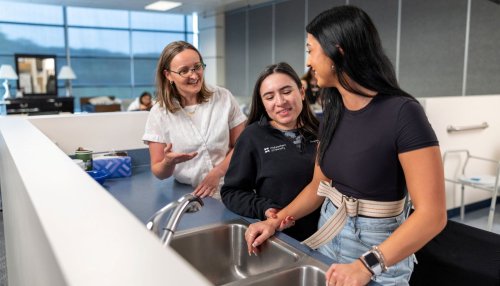
Program Overview for Proposed Master of Occupational Therapy, Downers Grove
The proposed Occupational Therapy Program offers a curriculum leading to the Master of Occupational Therapy (M.O.T.) degree at the Downers Grove, IL campus. This full-time, continuous, entry-level master's curriculum is designed to deliver the academic and clinical education required to prepare students for their professional role as key members of the healthcare team and as integral practitioners in the healthcare delivery system. The curriculum for the Master of Occupational Therapy degree is a continuous, full-time program, extending 24 months from matriculation to graduation, with a maximum completion time of 36 months.
Curriculum Highlights
The Master of Occupational Therapy Program offers a balanced combination of foundational, clinical, and experiential coursework designed to prepare future occupational therapists to optimize the lives, health, and well-being of individuals, groups, and populations. Of the 118 required credits in the curriculum, approximately one-fourth are earned in foundational OT; one-half are focused on OT process and practice courses; and one-fourth of the credits are concentrated on experiential fieldwork. The strong curricular framework succeeds in preparing graduates who are able to enter the profession of occupational therapy and make a difference in the world.
Accreditation
The entry-level occupational therapy master’s degree program has applied for accreditation by the Accreditation Council for Occupational Therapy Education (ACOTE) of the American Occupational Therapy Association (AOTA), located at 7501 Wisconsin Avenue, Suite 510E, Bethesda, MD 20814. ACOTE’s telephone number c/o AOTA is 301-652-AOTA and its web address is www.acoteonline.org.
The program must be granted Candidacy Status, have a preaccreditation review, complete an on-site evaluation, and be granted Accreditation Status before its graduates will be eligible to sit for the national certification examination for the occupational therapist administered by the National Board for Certification in Occupational Therapy (NBCOT). After successful completion of this exam, the individual will be an Occupational Therapist, Registered (OTR). In addition, all states require licensure to practice; however, state licenses are usually based on the results of the NBCOT Certification Examination. A felony conviction may affect a graduate’s ability to sit for the NBCOT certification examination or attain state licensure.
Midwestern University is accredited by The Higher Learning Commission 230 South LaSalle Street, Suite 7-500, Chicago, IL 60604-1411.
Learn More
Learn more about the requirements and find quick links to relevant catalog content to guide you in your application process.
The Midwestern University Occupational Therapy Program prepares future occupational therapists to optimize the lives, health, and well-being of individuals, groups, and populations through student-centered education, collaborative mentorship, and innovative learning experiences.
The Occupational Therapy Program offers a curriculum leading to the Master of Occupational Therapy (M.O.T.) degree for qualified students. The full-time, continuous, entry-level master’s curriculum is designed to deliver the academic and clinical education required to prepare students for their professional role as key members of the healthcare team, and as integral practitioners in the healthcare delivery system. The curriculum for the Master of Occupational Therapy degree is a continuous, full-time program, extending 24 months from matriculation to graduation. The maximum allotted time for completion of this program is 36 months. It is also required that all Level II fieldwork requirements must be fulfilled within 18 months of completion of the didactic portion of the program.
The Master of Occupational Therapy Program offers a balanced combination of foundational, clinical, and experiential coursework designed to prepare future occupational therapists to optimize the lives, health, and well-being of individuals, groups, and populations. Of the 118 required credits in the curriculum, approximately one-fourth are earned in foundational OT; one-half are focused on OT process and practice courses; and one-fourth of the credits are concentrated on experiential fieldwork. The strong curricular framework succeeds in preparing graduates who are able to enter the profession of occupational therapy and make a difference in the world.
The Occupational Therapy Program is open on a competitive admission basis to applicants who have received a bachelor's degree in any field, but who have not completed an accredited occupational therapy program. The Program does not accept students who transfer from another Occupational Therapy Program. The curriculum is designed to prepare entry-level practitioners to provide occupational therapy services in the home, community, and clinical practice settings that require independent judgment, leadership, and self-directed practice. The educational experiences provide the foundation for graduates to identify and contribute to effecting solutions to the major emergent health issues of society and to contribute to the clinical education of future occupational therapy practitioners. The curriculum is designed to prepare graduates for varied roles within occupational therapy, such as practitioner, manager, educator of consumers and peers, and foster leadership roles as faculty, consultant, or entrepreneur. The graduate will be well-prepared to make meaningful, ongoing contributions to individuals, groups, communities, and the profession through collaborative efforts with others in occupational therapy and interdisciplinary education and practice.
Program Objectives
Upon completion of the Master of Occupational Therapy program, graduates are expected to:
- provide theory- and evidence-informed occupational therapy services in traditional and emerging areas of practice;
- meet the occupational needs of individuals, groups, and populations through advocacy, leadership, and interprofessional collaboration;
- use occupations to support meaningful engagement in activities that promote health, well-being and quality of life;
- engage in ongoing professional development through lifelong learning activities; and
- uphold the ethical standards and values of the occupational therapy profession.
These outcomes are accomplished through:
- a curriculum model based on intentionally sequenced courses that act as vital links between application, analysis, synthesis, and evaluation of knowledge, skills, and behaviors;
- critical application of current relevant theories and evidence to advance occupational therapy practice and contribute to occupational therapy knowledge;
- sequential implementation of simulated and authentic experiential learning experiences across the curriculum;
- occupation-focused coursework, fieldwork, and capstone experiences designed to facilitate critical and ethical reasoning;
- opportunities for individual and group work to develop intra- and interprofessional leadership skills and professional and ethical behaviors; and
- provision of student-centered mentorship and support to facilitate professional development.
The College of Health Sciences Master of Occupational Therapy (M.O.T.) Program considers for admission those applicants who possess the academic and professional promise necessary for development as competent, caring members of the healthcare community. To select these candidates, a competitive admissions framework has been established for applicants who have received a bachelor's degree in any field, but who have not completed an accredited occupational therapy program.
Within this competitive admissions framework, multiple criteria are used to select the most qualified candidates from an applicant pool that exceeds the number of seats available. Interested individuals are advised to complete their application as early as possible to ensure timely consideration.
The Midwestern University Master of Occupational Therapy (M.O.T.) Program uses the Centralized Application Service for Occupational Therapy Schools (OTCAS) for students applying to the program. The Master of Occupational Therapy (M.O.T.) Program operates on a rolling admissions basis in which completed applications are reviewed throughout the admissions cycle to determine application eligibility for interviews. Interviews are typically conducted during the winter and spring.
Applications are due in OTCAS (https://otcas.liaisoncas.com/) by April 1st. Applications received after April 1st may be considered for available seats or placement on the alternate list. Please refer to the OTCAS website for instructions on submission of OTCAS application materials.
Individuals applying for admission to the College of Health Sciences Occupational Therapy Program must submit documentation for the following minimum requirements before the academic year commences for the incoming class:
- Completion of a baccalaureate degree from a regionally accredited college or university.
- A minimum cumulative undergraduate grade point average (GPA) of 2.75 on a 4.00 scale is encouraged. Grades of C or better are required for prerequisite coursework; grades of C- are not acceptable.
- Completion of the minimum number of prerequisite courses in the prescribed subject areas at regionally accredited colleges or universities. (See Prerequisite Courses section below)
- Satisfaction of the standards set forth by the Admissions Committee (including documentation of academic and professional promise in prospective students).
- Completion of the Occupational Therapy Program's interview process. On-campus interviews are by invitation only. Applicants are invited to an interview based on evidence supportive of excellence in:
- Academic achievement
- Oral and written communication skills
- Articulation of the domain and scope of OT practice
- Community service
- Leadership in extracurricular or other activities
- Demonstration of a people or service orientation through community service or extracurricular activities.
- Motivation for and commitment to healthcare as demonstrated by previous work, volunteer work, or other life experiences.
- Oral and written communication skills necessary to interact with clients and colleagues.
- Commitment to abide by Midwestern University Drug-Free Workplace and Substance Abuse Policy.
- Passage of the Midwestern University criminal background check.
Students must complete these courses with a grade of C or better; grades of C- are not acceptable:
Course | Semester/Quarter Hours |
|---|---|
Human Anatomy1, 2 | 3 Sem/4 Qtr hrs |
Physiology1 | 3 Sem/4 Qtr hrs |
Statistics or Research Methods | 3 Sem/4 Qtr hrs |
Lifespan Development | 3 Sem/4 Qtr hrs |
Abnormal Psychology | 3 Sem/4 Qtr hrs |
Other Social and Behavioral Science | 3 Sem/4 Qtr hrs |
1The Anatomy and Physiology requirements may also be fulfilled by taking Anatomy and Physiology I and Anatomy and Physiology II, as some universities offer combined courses.
2Human Anatomy must be completed successfully within 5 years of admission to the Program. The lab component with cadaver experience is strongly recommended.
Other courses in basic sciences, psychology, anthropology, math, human development, research, and human movement may be considered as alternates to the stated minimum prerequisites. The Occupational Therapy Program Admissions Committee will assess and determine if a candidate’s alternative coursework may meet the prerequisite requirements.
Transfer Policy
The Midwestern University MOT Program will not accept Advanced Placement credits for fulfilment of prerequisite coursework.
The Midwestern University MOT Program does not allow transfer credits from external universities. The Midwestern University Occupational Therapy Program may allow for transfer of credits from the Doctor of Occupational Therapy (OTD) Program to the MOT Program and vice versa pending application and approval. The Midwestern University MOT Program does not award credits for experiential learning or previous educational or work experience.
To be considered for admission to the Occupational Therapy Program, applicants must submit the following to the Office of Admissions:
- OTCAS Application: Applicants are required to submit their applications to OTCAS at https://otcas.cas.myliaison.com/applicant-ux/#/login by April 1, 2027.
- Please refer to the OTCAS application instructions for specific details about completing the application, required documents, and processing time.
- The OTCAS application should be available for applicants beginning in Summer 2026.
- Due to the large number of applications and the limited number of seats available, applicants are strongly encouraged to complete their OTCAS application early in the cycle.
- Letters of Recommendation: Applicants are required to submit a minimum of two letters of recommendation from professionals to OTCAS (https://otcas.cas.myliaison.com/applicant-ux/#/login). The Office of Admissions will only accept letters of recommendation received directly from OTCAS.
- It is preferred that one of the submitted letters is written by an occupational therapist who has supervised or mentored the applicant or a professional who can speak to the applicant's motivation, experiences in occupational therapy, or readiness for entering the Occupational Therapy Program.
- The second letter can be written by either a college professor who actually taught the student or a pre-health advisor who knows the applicant well.
- The applicant should refer to the OTCAS application instructions for specific guidelines and requirements for submitting letters of recommendation.
- Completed Applications:
- The Office of Admissions will automatically send letters verifying receipt of OTCAS applications with all required materials to all applicants who meet the minimum cumulative GPA requirement of 2.75.
- Exceptions may be made for GPAs below 2.75 depending on circumstances. Applicants with a cumulative GPA below 2.75 should contact the OT Program directly to request consideration. They can email the Admissions Chair at esimps@midwestern.edu.
- The letters will also include instructions on checking the status of the required application materials online. Applicants are responsible for tracking the receipt of their application materials and ensuring the submission of all required documents. Only applicants who submit completed applications with all required application materials will be considered for potential entrance into the Program.
- Notify the Office of Admissions regarding applicant mailing or email address changes:
- Applicants are responsible for notifying the Office of Admissions of any changes in their mailing address or email address.
- Withdrawal Requests:
- All application withdrawal requests must be made in writing via e-mail, fax, or letter to:
Midwestern University
Office of Admissions
555 31st St. Downers Grove, IL 60515
Fax: 630-971-6086
admissil@midwestern.edu
- All application withdrawal requests must be made in writing via e-mail, fax, or letter to:
What is the minimum GPA required for admission?
- You are encouraged to have a minimum cumulative undergraduate grade point average (GPA) of 2.75 on a 4.00 scale. Exceptions may be made for GPAs below 2.75 depending on your circumstances. Please contact the program directly to request consideration at esimps@midwestern.edu. Grades of C or better are required for prerequisite coursework; grades of C- are not acceptable.
Do I need to take the GRE?
- No, GRE scores are not required to apply.
Do I have to complete all of the prerequisite courses before I submit my application?
- You do not have to have your prerequisites completed prior to applying to the program. All of your courses must be complete before matriculation into the program.
Does it matter when I completed my prerequisites or when I obtained my baccalaureate degree?
- It does not matter how recently you earned your degree. In fact, we encourage people to apply who are considering a career change, or may be returning to graduate school after an absence. However, it is required that the Anatomy and Physiology courses have been completed within the previous five years.
What are the undergraduate majors of your students?
- There is no specific major required for our program, as long as all of the prerequisite courses are completed. Our students have baccalaureate degrees in all areas, with the most common being psychology, kinesiology, and exercise science. We encourage students from diverse academic backgrounds to apply; many of our students majored in areas such as business, art, and English.
What are the most important qualifications that you look for in an applicant?
- We look for applicants who are well-rounded and have a strong history of academic excellence, a commitment to service, and experience in leadership roles. We look for applicants who are person-centered and who are sensitive to individuals or groups who experience disability, social stigma, or limited access to healthcare.
Are there certain settings you prefer my OT observations to be in? How many hours of observations do I need?
- We do not require a certain number or type of OT observations. We prefer applicants to observe or experience OT in diverse settings to ensure that the applicant understands the variety of settings and practice within OT. We also encourage applicants to consider opportunities to observe in other healthcare and social service fields where they will encounter diverse populations.
Students selected for an interview will be notified of available interview dates and invited by the Office of Admissions to schedule their virtual interview.
During each interview session, the interviewers question the applicant about their academic, personal, and professional aspirations and preparedness for admission to the Occupational Therapy Program, and rate prospective students on a standard evaluation form. These evaluations are included in applicant files provided to the Occupational Therapy Admissions Committee. The Occupational Therapy Admissions Committee meets approximately one to two weeks after the interviews. The Admissions Committee, which includes the Program Director, makes decisions for action with oversight from the Dean of the College of Health Sciences. The Dean, via the Office of Admissions, notifies applicants in writing of the admission action/decision. Applicants are extended acceptance to the program based on the aggregate qualitative and quantitative data gathered from the application, interview process, and the completion of all published admissions requirements.
The Dean of the College of Health Sciences may recommend for an interview applicants who meet the Program’s minimum requirements for which they are applying (e.g., children of alumni, faculty, or staff). These applicants are not guaranteed admission into a Program and will have their application reviewed similarly to other applicants being considered for acceptance. All admissions decisions are made by the program Admissions Committee.
The Master of Occupational Therapy curriculum is composed of 64 required course credits (quarter hours) for the first academic year and 54 required course credits for the second academic year, for a total of 118 quarter credits. All courses in each quarter are prerequisite to courses in the subsequent quarter.
Three 1-credit Level I Fieldwork courses are placed within the first year of the curriculum and continue into the second year. Level I Fieldwork courses provide students with the opportunity to apply and refine previously learned skills to authentic contexts and prepare for further development of professional reasoning and collaborative relationship-focused practice skills in future courses throughout the curriculum. Two 12-credit Level II Fieldwork experiences are placed at the end of the second year in the curriculum. These fieldwork courses provide opportunities for students to develop competence and confidence to effectively practice as entry-level OT practitioners who use professional reasoning and collaborative relationship-focused practice to address occupational justice and the doing, being, becoming, and belonging of the people with whom they work.
The Midwestern University College of Health Sciences Master of Occupational Therapy Program reserves the right to alter its curriculum however and whenever it deems appropriate.
Summer I
- OTHED 501 Professional Development I
This course is the first in a series of three courses in which students begin to develop their professional identities and reflect on their belonging to the occupational therapy profession. This course introduces students to occupational therapy’s values, ethical standards, history, and scope of practice. Students will explore the concepts of professionalism and leadership and create their professional development plans. (2 credits) - OTHED 505 Neuroscience for Occupation
This course provides students with an essential knowledge base of neuroscience for understanding the ways in which the principle structural components, corresponding functions of the nervous system, and neurological dysfunction impact human occupation. Specific emphasis will be placed on the integrated influences of the autonomic nervous system, sensory processing, motor control, emotion and behavior control, and cognitive and executive functions on occupational performance. (3 credits) - OTHED 520 Occupation
This course provides students with a thorough foundation for understanding the complex nature of occupation and its contribution to the creation of one’s identity and roles, both personal and societal. Occupational science, meaningful activity, and the essential historical tenets of occupational therapy are emphasized using current and historical research and literature. (3 credits) - OTHED 550 Therapeutic Communication
This course provides students with an in-depth introduction to the intentional relationship and the essential dimensions of using communication therapeutically. The intentional relationship; therapeutic use of self; and the critical skills of interviewing, actively listening, and effectively responding to others based on client interpersonal characteristics will be emphasized for developing the occupational profile and serving clients across the lifespan. Students will develop self-awareness and empathy to support the use of oneself as an artful, skilled professional. (3 credits) - OTHED 555 Analysis of Occupations
This lab-based course emphasizes the development of the unique analytic skills occupational therapists use to assess, address, and influence occupational performance and engagement. Students learn to analyze the complex and dynamic interaction of internal and external factors that impact occupational performance and participation. The use of everyday activities, the ability to up- and down-grade occupations and understanding how occupations contribute to patterns of daily life will be highlighted. (3 credits) - OTHED 580 Critical Analysis of Evidence
This course provides content foundational to understanding and applying current research that affects practice and the provision of occupational therapy services. Students learn the concepts of evidence-informed practice, analysis of current professional literature, and understanding and interpreting basic research methodologies. Choosing an area of research focus and developing appropriate research questions will be emphasized. (3 credits)
Fall I
- OTHED 503 Movement for Occupation
This lab-based course covers the interrelationships between structural design and functional capabilities of the human body for use in the enactment of occupational performance. Principles from anatomy, neuromotor control, and kinesiology will be highlighted in relation to their influence on daily task performance and purposeful activities. Students will have the opportunity to develop competence in foundational occupational therapy evaluation and intervention skills related to movement, including joint range of motion measurement, manual muscle testing, and safe transfer techniques. (5 credits) - OTHED 530 Theoretical Foundations of OT
This course provides students with philosophical assumptions, theories, models of practice, and frames of reference that are central to occupation-focused therapy. Using the work of occupational therapy scholars, students will actively engage in reading, discussion, and evaluation of occupational therapy models of practice to learn how they apply to enacting the occupational therapy process with individuals, groups, and populations. (3 credits) - OTHED 535 Conceptual Approach to Conditions
This course addresses an approach to conceptualizing the different types of human conditions that often precipitate the need for occupational therapy services. Developmental, medical, neurological, orthopedic, and psychiatric categories of conditions will be explored with emphasis placed on the conceptual considerations that guide the identification and evaluation of a person’s occupational needs. (3 credits) - OTHED 540 OT Process: Foundations
This course underscores the importance of the OT process for enacting the practice of occupational therapy. Students will acquire an in-depth understanding of the professional reasoning processes needed for occupational therapy evaluation and intervention with individuals, groups, and populations across the lifespan. (2 credits) - OTHED 581 Research Project Development
This course continues to emphasize evidence-informed practice, allowing students to apply previously learned skills in analyzing evidence. Using self-directed learning, students will work in small groups to analyze and evaluate evidence on a research topic and develop a literature review. They will use the literature review to inform the design of a subsequent research study that could be used to address identified gaps in the research. (2 credits) - CORED 1599 Interprofessional Education
Changes in our healthcare delivery system create a growing demand for health professionals with skills in collaboration and teamwork. This course will describe the roles and responsibilities of the various healthcare disciplines. It will also provide students, from different health professions, the opportunity to interact with one another as well as simulated patients. This collaboration will promote communication using a team-based approach to the maintenance of health and management of disease. (1 credit) - OTHED 511 Fieldwork I-A
This course provides students with their first opportunity to apply foundational skills from previous and concurrent courses into community-based settings that serve individuals with or without disabilities. With the guidance and mentorship of an on-site supervisor, students will hone their therapeutic use of self in interactions with others, interviewing skills, and development of occupational profiles. Psychosocial dimensions of human occupation will be emphasized throughout this fieldwork experience. (1 credit)
Winter I
- OTHED 545 OT Process: Children
This lab-based course emphasizes the application of occupational therapy models of practice for the implementation of the OT process in pediatric settings. Assessments, documentation, goal writing, and intervention planning will be highlighted for practice with infants, children, and adolescents. Critical reasoning, prioritization of developmental considerations, family systems, and occupation-based practice will be stressed. (4 credits) - OTHED 547 OT Process: Adults
This lab-based course emphasizes the application of occupational therapy models of practice for the implementation of the OT process in adult settings. Assessments, documentation, goal writing, and intervention planning will be highlighted for practice with adults of all ages. Critical reasoning, issues of health and disability, adult roles, and occupation-based practice will be stressed. (4 credits) - OTHED 549 OT Process: Psychosocial
This lab-based course emphasizes the application of occupational therapy models of practice for implementation of the OT process in settings where people have psychosocial needs. Assessments, documentation, goal writing, and intervention planning will be highlighted for practice with people across the lifespan with psychosocial needs. Critical reasoning, management of mental health conditions, and occupation-based practice will be stressed. (4 credits) - OTHED 560 Adaptations for Occupations
This course emphasizes the importance of adaptations and modifications to facilitate occupational performance and participation for individuals, groups, and populations across the lifespan. Students will learn a variety of assistive technologies, adaptive equipment, and modified techniques that can be implemented into daily habits and routines to facilitate safety, independence, and engagement. (3 credits)
Spring I
- OTHED 551 OT Group Process
This lab-based course focuses on the ways in which groups are used in occupational therapy practice across different settings and with a variety of populations. This course emphasizes the theoretical approach, design, and implementation of groups while highlighting issues related to the phases of group development, establishing cohesion, managing conflict, and the application of interpersonal and therapeutic skills in group contexts. (3 credits) - OTHED 561 OT for Upper Extremity Function
This lab-based course highlights occupation-focused and occupation-based approaches to occupational therapy intervention for enhancing upper extremity function impacted by certain orthopedic and neurologic conditions. The use of interventions to support occupations, such as the design and application of orthotic devices, is included in this course. (3 credits) - OTHED 575 OT Process: Community & Population Health
This course emphasizes the application of the OT process to promote health, wellness, and occupational performance and participation for communities and populations. Students learn to identify and assess the needs and capacities of groups and populations in existing and emerging areas of practice to set the foundation upon which new and innovative programs may be developed. The collaborative and interpersonal skills needed to develop strong relationships with community partners and advocate for occupational justice for groups and populations will be stressed. (4 credits) - OTHED 579 OT Practice: Psychosocial
This course focuses on the application and synthesis of OT practice with people with psychosocial needs across varied practice settings. Case-based and authentic methods are used to enhance student evaluation and intervention skills for psychosocial practice. Major focus areas include trauma-informed care, occupational therapy contributions to evidence-based practices such as supported employment and education, cognitive implications of psychosocial conditions and substance use, and social determinants of health (4 credits) - OTHED 513 Fieldwork I-B
This course provides students with their second opportunity to apply foundational skills from previous and concurrent courses into community-based settings that serve individuals with or without disabilities. With the guidance and mentorship of an on-site supervisor, students will hone their observation and documentation skills. Psychosocial dimensions of human occupation will be emphasized throughout this fieldwork experience. (1 credit)
Summer II
- OTHED 645 OT Practice: Children
This lab-based course focuses on the application and synthesis of OT practice with infants, children, and adolescents across varied practice settings. Case-based and authentic methods are used to enhance students’ evaluation and intervention skills for pediatric practice. Major focus areas include designing and implementing evidence-informed, occupation-based interventions to promote participation in play, activities of daily living, education, leisure, and community life using collaborative, family-centered, and contextually relevant approaches. (4 credits) - OTHED 647 OT Practice: Adults I
This lab-based course focuses on the application and synthesis of OT practice with adults of all ages across varied practice settings. Case-based and authentic methods are used to enhance student evaluation and intervention skills for adult practice. Major focus areas include designing and implementing evidence-informed, occupation-based interventions to promote participation in ADLs, IADLs, work, and leisure. (4 credits) - OTHED 665 Modalities for Occupation
This lab-based course introduces the application of physical agent modalities as interventions to support occupations. Modalities using temperature, electricity, and pressure will be highlighted. Students will learn how to determine safe and appropriate uses of modalities given specific precautions or contraindications. This course meets the didactic training requirement for use of physical agent modalities in Illinois according to the Illinois OT Practice Act Rules. (2 credits) - OTHED 670 Disability & Policy
This course will analyze contemporary concepts, issues, legislation, and public policy decisions within healthcare and education systems and society that impact the lives of people with disability. This course will review key definitions of disability within the context of significant models and emphasize learning from lived experiences to understand how to advocate for occupational justice for and with the disability community. (2 credits) - OTHED 675 OT Practice: Community & Population Health
This course focuses on the application and synthesis of OT practice with communities and populations. Students build on their knowledge of needs and capacity assessments and learn to develop and evaluate programs to address health, well-being, and occupational performance and participation within agencies, organizations, and community settings. This course will continue the emphasis on collaborative and interpersonal skills needed to maintain strong relationships with community partners and advocate for occupational justice for groups and populations. (4 credits) - OTHED 615 Fieldwork I-C
This course provides students with an opportunity to apply foundational skills from previous and concurrent courses into traditional occupational therapy settings that serve individuals with disabilities across the lifespan. With the guidance and mentorship of an on-site supervisor, students will hone their occupational therapy evaluation and intervention skills. Psychosocial dimensions of human occupation will be emphasized throughout this fieldwork experience. (1 credit)
Fall II
- OTHED 602 Professional Development II
This is the second of three courses in which students will deepen their understanding of being an occupational therapy professional. This course is positioned between the Level I and Level II Fieldwork rotations to afford students an opportunity to reflect on and prepare for leadership, ethical dilemmas, and professional responsibility. Students will focus on their professional behaviors and their responsibilities in relation to supervisory and client-therapist relationships in fieldwork settings. (2 credits) - OTHED 623 Occupational Justice
This course provides a comprehensive exploration of occupational justice, particularly for people from historically marginalized or underrepresented backgrounds or identities. Students will have opportunities to discuss and critique the psychosocial effects and occupational impact of systematized castes, normativity, oppression, “isms” and other discriminatory attitudes or beliefs in current society. Opportunities to learn from lived experiences and apply coursework to experiential learning will be included in this course. (2 credits) - OTHED 655 Administration & Management
This course provides students with the foundational knowledge and skills to assume administrative or management roles and responsibilities. Students learn skills in leadership, strategic planning, business plans, legal and reimbursement issues, departmental budgeting, inventory management, supervision, and personnel management. (3 credits) - OTHED 657 OT Practice: Adults II
This course provides students with a deeper understanding of evidence-based occupational therapy intervention for adults with chronic, permanent, or progressive conditions. Functional cognition and neuromotor approaches will be highlighted. Students will further develop their professional reasoning skills to support effective application of restorative, compensatory, and adaptive approaches to improving client occupational performance and participation. (3 credits)
Winter II
- OTHED 638 Fieldwork II-A
This rotation is composed of supervised field experience with clients and/or client groups who exhibit a variety of medical, developmental, or psychosocial conditions. This rotation emphasizes the development of disciplined, higher-level critical reasoning skills necessary to plan and provide occupation-based and occupation-focused services. (12 credits)
Spring II
- OTHED 639 Fieldwork II-B
This rotation is composed of supervised field experience with clients and/or client groups who exhibit a variety of medical, developmental, or psychosocial conditions. This rotation emphasizes the development of disciplined, higher-level, critical-reasoning skills necessary to plan and provide occupation-based and occupation-focused services. (12 credits) - OTHED 603 Professional Development III
This is the third of three courses in which the student explores issues related to professionalism and becoming part of the occupational therapy profession. This course is positioned after the completion of Level II-B Fieldwork in the last quarter of the program. Students will construct goals and plans for continued professional development, learn how to successfully study for the National Board for Certification in Occupational Therapy examination after graduation, and prepare for obtaining positions as occupational therapy professionals. (2 credits)
The Technical Standards set forth the nonacademic abilities considered essential for students to achieve the level of competence required by the faculty to obtain the academic degree awarded by the college.
Candidates must be able to perform the following skills or demonstrate the following capabilities:
- Observation: The candidate must be able to perceive, assimilate, and integrate information through observation of individuals and the environment. Observation necessitates adequate functional use of any combination of visual, tactile, auditory, and other sensory and perceptual modalities to enable such observations and information acquisition.
- Communication: The candidate must be able to communicate effectively, efficiently, and sensitively using a combination of verbal, non-verbal, alternative, and written formats.
- Motor: Candidates must be able to guide or direct others or use fine and gross motor skills to transport, position, maneuver, and/or manipulate self, other persons, and objects.
- Intellectual, Conceptual, and Integrative Abilities: The candidate must be able to problem solve, measure, calculate, reason, analyze, record, synthesize, and summarize large amounts of information in a timely manner.
- Behavioral and Social Attributes: The candidate must possess adequate self-regulation skills to fulfill roles and responsibilities effectively under stress. The candidate must take responsibility for professional competence, conduct, and growth through self-assessment. The candidate must exercise good judgment to respond to situations ethically and safely. The candidate must develop and maintain respectful, non-judgmental working relationships with all individuals from every lifestyle, culture, identity, and background. The candidate must be able to adapt to changing environments, to display flexibility, and to learn to function in the face of uncertainties. Compassion, integrity, concern for others, effective interpersonal skills, willingness and ability to function as an effective team player, and interest and motivation to learn are all personal qualities required during the educational process.
Candidates are required to verify that they understand and are able to meet these Technical Standards at least four weeks prior to matriculation (or if admitted later, within one week of deposit). Candidates who may only meet technical standards with accommodation, must contact the Office of Student Services to make a formal request for accommodation. The Dean of Students, in consultation with the College Dean/Program Director, will determine what reasonable accommodations can be provided, if any. The College is not able to grant accommodations that alter technical or educational standards of the curriculum.
Students must meet the technical standards for the duration of enrollment at the College. After matriculation, if a student fails to continue to meet the technical standards during subsequent enrollment, the student may apply for accommodation by contacting the Office of Student Services. If the accommodation needed to meet the technical standards alters the educational standards of the curriculum, the student's ability to satisfactorily progress in the curriculum will be evaluated by the appropriate College's Student Graduation and Promotion Committee. Accommodations cannot be applied retroactively. Please refer to the Student Handbook for more information about applying for, receiving, and implementing accommodations.
The Master of Occupational Therapy Program is a fully in-person program with all didactic courses occurring on the Downers Grove campus.
- Experiential learning activities may occur at community sites around the Chicagoland area.
- Fieldwork courses will occur at any affiliated fieldwork site in Illinois or across the United States.
The campus is located at 555 31st Street, Downers Grove IL, 60515. Buildings, classrooms, offices, and other spaces on campus are accessible according to the Americans with Disabilities Act.
Students in the Master of Occupational Therapy Program are formally evaluated at appropriate intervals during the curriculum to assess and document satisfactory progress and achievement of learning objectives and prescribed competencies. These evaluations occur on a regular basis at scheduled times during each course. Depending on the learning and competency outcome objectives, these evaluations are designed to assess the level of knowledge, problem-solving skills, psychomotor and clinical competencies, and behavioral performances of students during each course and/or fieldwork experience. Evaluation methods vary, depending on the course or experiential learning opportunity, and may include formal examinations, written essays, portfolio assignments, design and fabrication projects, psychomotor skill checks, or other methods of determining the extent to which each student has mastered the course content and skill competencies. Student performance in formal examinations is graded on a numerical/alphabetical system using a standard grading scale, which is published in Midwestern University Catalog. Students are customarily provided with feedback and grade reports after each examination summarizing their performance on each test item. Students will be required to participate in competency-based evaluations at various intervals throughout their academic tenure.
Evaluations of student performance during the Fieldwork II experiences are formalized using standard evaluation tools established by the American Occupational Therapy Association. In keeping with the Program's mission to exceed national standards, the Occupational Therapy Program reserves the right to augment the performance criteria required to successfully complete the Fieldwork Level II courses.
The academic standing of a student is determined by the student's cumulative grade point average. The student must pass all courses and maintain a cumulative grade point average of 3.0 or higher to have achieved satisfactory academic progress. A student must satisfactorily complete all didactic courses and academic requirements from the preceding quarter.
To qualify for the Master of Occupational Therapy degree (M.O.T.), students must:
- Satisfactorily complete all courses with a minimum cumulative GPA of 3.00 or higher;
- Satisfactorily complete the required minimum number of 118 credit hours in the curriculum;
- Receive a favorable recommendation for master's degree conferral from the Program faculty to the Program Student Academic Review Committee and from this committee to the CHS Student Promotion and Graduation Committee;
- Receive a favorable recommendation for master's degree conferral from the University Faculty Senate;
- Settle all financial accounts with the University; and
- Complete all graduation clearance requirements as instructed by the Office of the Registrar.
Occupational Therapy is a registered and/or licensed profession in all 50 states. To become licensed to practice as an occupational therapist in most states (including Illinois), a student must graduate from an ACOTE-accredited or approved educational program and pass the national certification examination for the occupational therapist administered by the National Board for Certification in Occupational Therapy (NBCOT). Most states (including Illinois) require status as an occupational therapist registered (OTR) to become a licensed occupational therapist (OTR/L). A prior felony conviction may affect a graduate's ability to sit for the NBCOT Certification Exam or attain state licensure.
Midwestern University’s Master of Occupational Therapy program is designed to meet the educational requirements to meet the licensure requirements to practice as an occupational therapist in the following states and territories: Alabama, Alaska, Arizona, Arkansas, California, Colorado, Connecticut, District of Columbia, Delaware, Florida, Georgia, Hawaii, Idaho, Illinois, Indiana, Iowa, Kansas, Kentucky, Louisiana, Maine, Maryland, Massachusetts, Michigan, Minnesota, Mississippi, Missouri, Montana, Nebraska, Nevada, New Hampshire, New Jersey, New Mexico, New York, North Carolina, North Dakota, Ohio, Oklahoma, Oregon, Pennsylvania, Puerto Rico, Rhode Island, South Carolina, South Dakota, Tennessee, Texas, Utah, Vermont, Virginia, Washington, West Virginia, Wisconsin, Wyoming.
The Master of Occupational Therapy program curriculum has not made a determination if the program meets the requirements in the territory of the U.S. Virgin Islands.
Each student should check the additional licensure requirements for the state, district or territory in which they intend to pursue employment.
Tuition and fees for each school year for the M.O.T. program is $54,728. For all 24 months of attendance, the total anticipated cost of tuition and fees for the M.O.T. program is $109,456. For all 24 months of attendance, the total anticipated cost of attendance for the M.O.T. program, which includes tuition, fees, books, food, housing, transportation, and other expenses, ranges from $168,857 (living with parents) to $203,657 (living off campus).
For detailed information about the anticipated total cost of attendance, please reference the M.O.T. 2027-28 Financial Aid Fact Sheet. The total cost of attendance figures include tuition/fees, estimates for books, supplies, and living expenses, etc.
Tuition rates are subject to change each academic year for all enrolled students. Visit the Tuition & Fees page for important information regarding tuition.
Visit the Leave of Absence, Withdrawal Notification, and Refund Policy page for the policy and procedure for leave of absence, withdrawal and refund.
For the Student Financial Services contact information, visit the Financial Aid page.
Unique funding opportunity: Midwestern University offers several financing options, including the MWU Loan. This is an excellent alternative or adjunct to Grad PLUS loans through the federal government. Student Financial Services provides information on this and several other loans available to students at Midwestern University.
Explore more details about our program by reviewing the following manuals:
Canvas Online Course Platform
Students will use Canvas to access their online courses. Assignments, discussions, syllabi, and all student resources are available through Canvas. The courses are asynchronous, so there is no need to be online at a specific time unless specified by your instructor. Students will become more familiar with the Canvas navigation after reviewing the videos in the main page of Canvas. Students can access their account through the Midwestern University portal (online.midwestern.edu).
Outlook Student Email
Each Midwestern University student is provided a Microsoft Office365 e-mail account. Students can access their account through the Outlook application on their Midwestern University portal (online.midwestern.edu). Students should check this email frequently to receive important communications from their professors, their college, and the University.
Virtual Meetings and Classroom Lectures
Midwestern University uses multiple online tools to access meetings and classes. Students may be required to use Microsoft Teams, WebEx, Canvas Collaborate, or Zoom depending on the activity. These applications all have downloadable installations that make the use of these services complete and robust. The student will be required to install the proper application to gain the full features of these applications. The student will be prompted to install those applications when they first access WebEx or Zoom. Canvas Collaborate is completely web-based and requires no other installs. MS Teams is a part of your MS 365 license you have as a student. Please login to the Midwestern University portal for additional information and directions on applications (support link in upper right).
Technical Policies and Resources
Network accounts are provided to students for their personal use while enrolled at MWU. Students are responsible for all activity associated with their account. Students must keep their passwords confidential and never share their account information with anyone else. Students must not pretend to be anyone else or attempt to represent the Program, College, or University in any official capacity while communicating with others. Students must follow the Computer Acceptable Use Policy in the student handbook. Students are expected to provide and maintain functional personal computing equipment and Internet access that meets or exceeds the minimum requirements below. Please note that these requirements may change from time to time.
Windows Based
- Operating System: Microsoft Windows 10 or later (Windows 11 preferred)
- Memory: 8 GB minimum (16 preferred)
- Processor: Intel Core i7 or greater (or AMD equivalent)
- Hard Disk Drive: 256 GB or greater with 100GB free for applications
- Wireless: 802.11ac
- Accessories: Speakers/Headphones, Microphone, Camera
Mac Based
- Operating System: OS – Latest MacOS or iOS (stay current within two versions for Apple Update/Security)
- Memory: 8 GB or higher (16GB preferred)
- Processor: Intel Core i7 or M2 or greater
- Hard Disk Drive: 256 GB or greater with 100GB free for applications
- Wireless: 802.11ac (Ethernet wired connection preferred)
- Accessories: Speakers/Headphones, Microphone, Camera
Other Devices
- iPads can be used provided they are able to run Apple’s current operating system.
- Chromebooks are not supported.
Software (Midwestern University portal, click on ‘support’ in the upper right)
- Microsoft Office 365 (Local installation of Office products is available from the University Portal)
- Microsoft Teams for complete online collaboration functionality
- All required “plug-ins” must be installed for all exam security and monitoring
- All additional plug-ins or applications to support online education (WebEx and Zoom)
Anti-Malware Scanners
- You should have anti-malware software installed and running on your computer when connected to the internet. Some of the most popular products include McAfee VirusScan, Norton (Symantec) AntiVirus and Sophos Anti-Virus.
Internet Access
20Mb download and 5 Mb upload broadband (cable or DSL) connection required. Dial-up is not supported.
- Test internet speed at www.speedtest.net
- Disable gaming and video streaming on all other devices using the same broadband network as the devices being used for the exam. Gaming and video streaming while taking an exam may interfere with the exam delivery and proctoring tools.
Support
Please contact the ITS Support Center at 623-232-4357 if you have difficulty accessing or using your Midwestern University portal account. If your computer hardware or software is not functioning properly, please contact the original equipment manufacturer or vendor who sold you the hardware or software or contact a local computer store for assistance.
Graduation and Pass Rates
Graduation Rates
Graduation rates will be updated after the first M.O.T. cohort graduates in 2029.
NBCOT Exam Passing Rates
Visit the NBCOT School Performance page for passing percentage rates by school: https://www.nbcot.org/EDUCATORS-FOLDER/SCHOOLPERFORMANCE.
Please note that NBCOT scores for graduates from the M.O.T. program will not be available until after the first cohort graduates in 2029.
Learn More
Our faculty are deeply committed to our students, offering mentorship and hands-on learning to prepare them for clinical practice.
Hear Our Stories
Monika Robinson, DrOT, Associate Professor, Occupational Therapy
"I oversee the Capstone process...And it was really rewarding for me to allow (students) to take initiative in these projects, to be self-directed, because then they could see that they were truly capable."