
Master of Science in Nursing / Family Nurse Practitioner - Hybrid
Earn your MSN Family Nurse Practitioner with our 24-month, hybrid program in Glendale, AZ, offering online coursework and clinical practice.
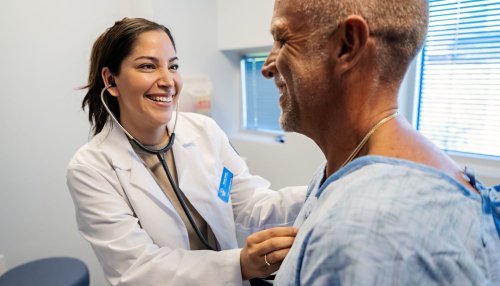
Fast Facts: MSN Family Nurse Practitioner-Hybrid Program
| Degree | Class Size | Duration | Modality | Program Start |
|---|---|---|---|---|
| M.S.N. | 24 | 24 month | Hybrid | Fall 2027 |
Proposed Master of Science in Nursing (MSN) Family Nurse Practitioner-Hybrid Program Overview
Midwestern University's hybrid Family Nurse Practitioner (MSN-FNP) program in Glendale, AZ prepares nurses to assess, diagnose, treat, and manage patients from childhood through older adulthood, with attention to health promotion, disease prevention, and family and community context.
Designed for working nurses, the program combines online coursework, required in-person learning experiences, and supervised clinical practice. Graduates are academically prepared to pursue national FNP certification and applicable advanced practice authorization.
Enrollment will not begin until all required approvals are in place, including those from the Arizona State Board of Nursing (BON), the Arizona State Board for Private Postsecondary Education (AZPPSE), the Commission on Collegiate Nursing Education (CCNE), and any other applicable authorities.
- Estimated application start date: February 2027
- Expected program start date: Fall 2027
Authorized States
The MSN Family Nurse Practitioner program is authorized to enroll students residing in Alaska, Arizona, Florida, Georgia, Hawaii, Idaho, Illinois, Indiana, Kentucky, Massachusetts, Maryland, Maine, Michigan, Missouri, North Carolina, Nebraska, New Jersey, New Mexico, Nevada, Ohio, Oklahoma, Rhode Island, South Carolina, South Dakota, Virginia, Vermont, Washington, and Wyoming.
Learn More
Learn more about the requirements and find quick links to relevant catalog content to guide you in your application process.
Admissions Requirements
To be considered for admission to the Master of Science in Nursing—Family Nurse Practitioner (MSN-FNP) Program, applicants must submit the following documented evidence:
- Completion of a baccalaureate degree in nursing granted by an institutionally accredited college or university.
- Current and unencumbered license to practice as a registered nurse in at least one legal jurisdiction in the United States and its territories.
- Submission of current resume or curriculum vitae (CV) to highlight current clinical, educational, or administrative practice related to nursing that can serve to facilitate the successful completion of an advanced nursing degree.
- A competitive undergraduate grade point average (GPA) (often preferred at 3.0 or higher on a 4.0 scale).
- Submit a letter of intent for graduate school admission.
Application Process and Deadlines
To be considered for admission into the Master of Science in Nursing (MSN)/Family Nurse Practitioner Program, applicants must submit the following to the University’s Office of Admissions:
- A completed Application for Admission form.
- Official transcripts verifying completion of a baccalaureate or higher-level degree in Nursing from an institutionally accredited college or university, and satisfactory completion of all prerequisite coursework with a grade of a “C” or higher (“C-“will not be accepted).
- Official final transcripts from all colleges attended.
Please be advised that applications are due no later than July 31st (early submissions are encouraged) through the NursingCAS website.
Questions related to the Midwestern University Admissions Portal can be directed to the office of admissions (888-247-9277 or 623-572-3215; admissaz@midwestern.edu) and general admissions questions can be directed to the Program Director (Dr. Logue: mlogue@midwestern.edu).
Please note: The receipt of the application materials and the file status can be tracked on the University's website. Upon receipt of the application, the Office of Admissions will send instructions for accessing account information. Applicants are responsible for notifying the Office of Admissions, at the above address, of any changes in mailing address and/or e-mail address.
All requests for withdrawal of an application must be submitted in writing via e-mail, fax, or letter to the Office of Admissions.
Selection Process
The MSN program at Midwestern University uses a rolling admissions process. Completed applications are reviewed, and decisions to admit candidates are made regularly during the admission cycle until the class is filled. The admissions committee reviews all completed applications to the MSN program and formulates and submits a recommendation to the Dean for final approval. The Dean, via the Office of Admissions, notifies applicants in writing of admission decisions. Applicants are required to submit their applications by July 31st. Applicants are notified of their selection status no later than two weeks after completing their file.
Reapplication Process
After receiving either a denial or an end-of-cycle letter, prospective students may reapply for the following year's admissions cycle. Before reapplying, however, applicants are encouraged to seek input on strengthening their application from a counselor in the Office of Admissions after the admissions cycle is officially over. To initiate the reapplication process, prospective students must complete and submit new applications and proceed through the standard application procedures.
Transfer Policy
The Master of Science in Nursing (MSN)/Family Nurse Practitioner Program may elect to accept transfer students. Transfer students must apply to the program. Any requests for consideration of transfer credit must be provided in writing by the student by July 31st. The request must include supporting documentation, including official transcripts, course syllabi, or course descriptions. Qualified students may transfer up to 12 credits for MSN programs, with individualized course evaluations by faculty that ensure alignment with program quality and accreditation standards. All transfer requests are reviewed prior to matriculation to provide clear, upfront decisions and a seamless start to your program. Transfer credit decisions are based on equivalency of course content, academic quality, and alignment with program outcomes and accreditation standards. All transfer credit requests are subject to approval by the Admissions Committee, which determines the number and type of graduate credits accepted, including both semester and quarter credit equivalencies. Note: Clinical specialty and practicum courses are non-transferable due to variability in clinical hours, supervision, and regulatory requirements.
Note:
- Programs may impose stricter limits based on specialty, certification, or regulatory requirements.
- The course must be completed at an accredited institution and as part of an accredited program.
- Minimum grade of B or higher
- Completed within the past 5 years
Time Limitations on Applicability
- Accepted transfer credits apply only to the program of admission.
- Credits cannot be re-applied to future programs without reevaluation.
FNP Overview
The goal of the MSN Family Nurse Practitioner program is to develop competent, ethical, and collaborative family nurse practitioners who can assess, diagnose, treat, and manage acute and chronic health conditions; promote health and prevent disease; and improve outcomes for diverse individuals, families, and populations. MSN-FNP graduates will be prepared for entry-level FNP practice. Graduates will be academically prepared to pursue national FNP certification and applicable advanced practice licensure or authorization.
FNP Curriculum Built for Advanced Clinical Practice
The MSN-FNP curriculum develops advanced assessment, diagnostic reasoning, and primary care management skills for patients from childhood through older adulthood.
Key areas of study:
- Advanced health assessment
- Advanced pharmacology
- Advanced pathophysiology
- Family primary care across the lifespan
- Disease prevention and health promotion
- Diagnostic reasoning
- Evidence-based practice
- Population health
- Care of children, adolescents, adults, and older adults
- Chronic disease management
Students learn to assess patients at different life stages, interpret diagnostic findings, develop evidence-based treatment plans, and coordinate care with patients, families, and other professionals.
Clinical Experience
Hands-on clinical training is central to becoming a successful nurse practitioner.
Students complete supervised clinical experiences that allow them to apply classroom knowledge in real patient-care environments while building confidence in:
- Patient assessment
- Diagnosis and treatment planning
- Preventive care
- Care coordination
- Clinical decision-making
These experiences support the transition from registered nurse to family nurse practitioner practice.
Career Opportunities
FNP graduates may work in:
- Family medicine and primary care practices
- Community health centers
- Outpatient care centers
- School-based and other community clinics
- Healthcare systems and integrated care networks
Accreditation
The master's degree program in nursing/ Family Nurse Practitioner program at Midwestern University is accredited by the Commission on Collegiate Nursing Education (http://www.ccneaccreditation.org).
In addition, the Family Nurse Practitioner program has been approved by the Arizona State Board for Private Postsecondary Education and the program is pending approval by the Arizona State Board of Nursing