
Program Purpose
Midwestern University College of Pharmacy-Downers Grove offers an American Society of Health-System Pharmacists (ASHP)-accredited postgraduate year two (PGY2) Ambulatory Care Pharmacy Residency with a primary practice site at Northwestern Medicine in Chicago, Illinois. The PGY2 Ambulatory Care Pharmacy Residency builds upon the Doctor of Pharmacy degree and postgraduate year one (PGY1) training to further develop clinical pharmacists in advanced ambulatory care practice. This program is specifically designed to prepare residents to function independently as ambulatory care practitioners by integrating clinical knowledge, longitudinal patient care experience, and evidence-based decision-making to optimize medication therapy and improve patient outcomes. Upon completion, residents are well prepared for advanced ambulatory care clinical pharmacist and/or academic faculty positions and are positioned to pursue board certification in ambulatory care.
The residency provides comprehensive, longitudinal experience where residents will develop expertise in managing complex patients through continuity of care while collaborating closely with interprofessional teams and specialty services. In addition to direct patient care, residents gain experience in practice management and service development, including learning how to design, implement, and expand clinical pharmacy services and demonstrate their value through outcomes and impact.
In parallel, residents engage in structured academic and teaching experiences to develop skills in didactic instruction, workshop facilitation, assessment development, and precepting. Residents will deliver a 1-hour lecture within a pharmacotherapeutics course, develop assessment questions, and have opportunities to contribute to teaching and assessment creation within elective courses. Residents will also facilitate workshops at Midwestern University and actively precept pharmacy students and PGY1 residents, fostering layered learning and mentorship. These experiences prepare residents for future roles in academia, clinical practice leadership, and professional education.
To support these goals, residency training includes approximately eight months at the primary practice site and four months of elective learning experiences tailored to the resident’s interests and career goals.
Residents are expected to train primarily at Northwestern Medicine, Monday through Thursday, at the primary practice site or elective site, and attend Midwestern University on Fridays for academic and teaching activities. Northwestern Medicine is located approximately 24 miles from Midwestern University. Residents are responsible for their own transportation, and gas or mileage reimbursement is not provided for travel between sites. Parking is available free of charge at Midwestern University, and discounted parking is available at Northwestern Medicine.
Primary Practice Site
Northwestern Medicine Internal Medicine Clinic
675 N. St. Clair Street, Suite 18-200, Chicago, IL 60611
This learning experience is based in the Internal Medicine Clinic on the 18th floor of Galter Pavilion at Northwestern Medicine in Chicago, Illinois. As the largest internal medicine clinic within the health system, it serves as a major academic primary care site with a high volume of patients and learners. The clinic includes approximately 50 attending physicians, 50 internal medicine residents, and rotating medical students, creating a robust, interprofessional teaching environment.
- Clinical pharmacists are fully embedded within the care team and maintain a dedicated office within the clinic. Under a collaborative practice model, pharmacists provide comprehensive medication management (CMM) services and work closely with physicians, medical assistants, nurses, and social workers to support patient care, including triage, medication reconciliation, care coordination, and follow-up. Pharmacists function as integral providers, independently initiating, adjusting, and discontinuing medications in accordance with evidence-based guidelines and individualized patient needs.
- Pharmacists also collaborate closely with cardiology, endocrinology, and other specialty services across the institution to ensure coordinated, team-based care for complex patients. This interprofessional approach enhances continuity of care and supports optimization of therapy across disease states.
- Pharmacists manage a panel of approximately 10–12 patients per day, delivering longitudinal care across a broad range of chronic conditions, including but not limited to heart failure, type 1 and type 2 diabetes, hypertension, hyperlipidemia, chronic kidney disease, asthma, COPD, cardiovascular-kidney-metabolic syndrome, smoking cessation, and primary and secondary cardiovascular prevention. Clinical responsibilities include comprehensive patient assessment, interpretation of laboratory and diagnostic data, risk stratification, development of therapeutic plans, and ongoing monitoring of outcomes.
- Additional responsibilities include providing drug information consultations, applying pharmacokinetic, pharmacodynamic, and pharmacogenomic principles, supporting transitions of care and post-discharge medication reconciliation, and participating in urgent care needs within the clinic.
- Pharmacists play a key role in educating internal medicine residents, medical students, pharmacy learners, and trainees from specialty areas, including cardiology and endocrinology. These teaching opportunities, combined with the collaborative practice environment, foster a rich, interprofessional learning experience that prepares residents for advanced ambulatory care and academic practice.
The Northwestern Medicine Internal Medicine Clinic is located approximately 24 miles from Midwestern University.
Primary Practice Site Preceptor
Christie Schumacher, Pharm.D., BCACP, BCPS, BCCP, CDCES, BC-ADM, FCCP
Professor of Pharmacy Practice
Residency Program Director, PGY2 Ambulatory Care Pharmacy Residency Program
Midwestern University College of Pharmacy
Clinical Pharmacist
Northwestern Medicine
Accreditation Status
The PGY2 Ambulatory Care Pharmacy Residency at Midwestern University College of Pharmacy, Downers Grove, is accredited by the American Society of Health-System Pharmacists.
Program Details
Key information about our program including strengths, structure and rotations, outcomes, residency qualifications, application requirements, and salary and benefits.
Longitudinal Ambulatory Care Practice Model
Residents gain extensive experience through a longitudinal ambulatory care practice embedded within a high-volume academic internal medicine clinic. This model provides exposure to a wide variety of disease states and emphasizes continuity of care, allowing residents to follow patients over time, assess outcomes, and refine clinical decision-making based on real-world experiences. Residents work closely with internal medicine residents and attendings in a longitudinal fashion, fostering strong interprofessional relationships and collaborative learning. The practice is primarily in-person, supporting development of patient communication, physical assessment integration, and real-time clinical problem solving.
Pharmacists are fully integrated into the healthcare team within a highly collaborative environment. Robust operational support, including medical assistants for rooming patients, schedulers for coordinating visits, and nurses and pharmacy technicians for prior authorizations and patient assistance program facilitation, allows pharmacists and residents to focus on high-level comprehensive medication management and practice at the top of their license.
Team-Based Care Across Specialties
Residents train within a deeply collaborative environment that extends beyond internal medicine to include close partnerships with cardiology, endocrinology, and other specialty services. This interprofessional model enhances the resident’s ability to manage complex cardiometabolic and chronic disease states while understanding specialty-specific considerations and transitions of care.
Strong Teaching and Academic Integration
Through a structured academic day and teaching opportunities across multiple learner levels, residents develop skills in didactic instruction, precepting, and curriculum development. Teaching experiences include pharmacy students, internal medicine residents, and specialty trainees (e.g., cardiology and endocrinology), preparing residents for academic and precepting roles.
Comprehensive Scope of Practice and Autonomy
Residents practice under a collaborative practice model that supports independent clinical decision-making, including initiating, modifying, and monitoring pharmacotherapy. This level of autonomy, combined with structured preceptor support, promotes progressive independence and prepares residents for advanced ambulatory care practice.
Service Development and Leadership Opportunities
Residents are actively involved in the development, implementation, and evaluation of ambulatory care pharmacy services. Through quality improvement initiatives, population health efforts, and exposure to operational workflows, residents build skills necessary to expand and sustain clinical pharmacy services in a variety of healthcare settings.
Positions: 1
Residency Start Date: July 1
Duration: 52 weeks
Staffing Requirements: There is no formal staffing requirement for this residency program. Non-clinic time is dedicated to academic and professional development activities, including teaching responsibilities, completion of research and scholarly work, and engagement in practice management and service development projects.
Required Learning Experiences
Learning Experience | Duration and Description |
|---|---|
Orientation | 4 weeks |
Ambulatory Care 1: | 6 weeks |
Ambulatory Care 2: | 8 weeks |
Ambulatory Care 3: | 8 weeks |
Ambulatory Care 4: | 8 weeks |
Research | Longitudinal |
Teaching and Learning | Longitudinal |
Ambulatory Care Administration | Longitudinal |
Elective Learning Experiences
Residents will complete a total of 16 weeks of elective learning experiences during the residency year. Rotations will depend on resident preference, learning needs, and preceptor availability. Electives may be structured as either:
- Two 8-week rotations
- One 8-week rotation and two 4-week rotations
- Four 4-week rotations
Additionally, residents will have the opportunity to participate in a 1-week American Diabetes Association diabetes camp experience as part of their elective time.
Elective experiences are designed to be tailored to each resident’s career interests and professional goals. Scheduling will be coordinated with the Residency Program Director to ensure alignment with desired areas of specialization while maintaining a well-rounded ambulatory care experience. Electives will provide opportunities for expanded clinical responsibility, interprofessional collaboration, and/or exposure to specialized patient populations. Elective learning experiences may occur outside of the primary clinic site based on resident interests and available opportunities.
Elective rotations may be developed within a variety of ambulatory care and specialty practice settings. Examples of disease states and focus areas include, but are not limited to:
- Diabetes and Endocrinology
- Cardiology
- Infectious Diseases – HIV and Hep C
- Geriatrics
- Oncology
- Population Health
- Psychiatry / Behavioral Health
- Rheumatology
- Specialty pharmacy:
- Inflammatory
- Neurology
- Oncology
- Women’s health and reproductive medicine
- Transitions of Care
- Transplant
Upon completion of this residency, the resident will be able to:
- Provide comprehensive, patient-centered medication management across diverse ambulatory care settings, integrating evidence-based guidelines, clinical expertise, and individualized patient factors to optimize outcomes.
- Function as an independent ambulatory care practitioner within a collaborative practice model, effectively initiating, modifying, and monitoring pharmacotherapy as part of an interprofessional healthcare team.
- Deliver high-quality, effective education to a variety of learners, including pharmacy students, residents, and interprofessional trainees, and demonstrate a sustained commitment to teaching and advancing the profession of pharmacy.
- Communicate clearly and effectively, both verbally and in writing, with patients, caregivers, and members of the interprofessional team to support shared decision-making and coordinated care.
- Design, implement, evaluate, and advance ambulatory care pharmacy services, including contributing to quality improvement initiatives and population health strategies.
- Collaborate with internal medicine and specialty services (e.g., cardiology, endocrinology) to provide integrated, team-based care for patients with complex chronic conditions.
- Demonstrate professionalism, leadership, and a commitment to continuous quality improvement through self-assessment, reflection, and ongoing professional development.
Applicants must meet the following criteria:
- Graduated from an ACPE-accredited pharmacy program with a Doctor of Pharmacy (PharmD) degree
- Successful completion of an ASHP-accredited PGY1 pharmacy residency
- Eligible for pharmacist licensure in the state of Illinois
Competitive candidates will demonstrate strong motivation, self-direction, and excellent communication skills. A commitment to teaching and a genuine interest in ambulatory care practice are essential.
Application Deadline:
- All application materials must be submitted through PhORCAS by January 5
Application Submission via PhORCAS:
- Current curriculum vitae (CV)
- Letter of intent outlining interest in the PGY2 Ambulatory Care Pharmacy Residency at Midwestern University and Northwestern Medicine
- Official pharmacy school transcript
- Three letters of recommendation using the standard PhORCAS recommendation form
Match Information:
- ASHP Match Number: #710690
- This PGY2 ambulatory care pharmacy residency program abides by ASHP Resident Matching Program policies and does not solicit, accept, or use ranking-related information from applicants
Additional Information:
- This program does not sponsor visas for pharmacy residency applicants
For additional details, please visit the PhORCAS website.
Stipend: $63,480
Faculty Appointment: Each resident will receive a faculty appointment as a Visiting Instructor in the Midwestern University College of Pharmacy Department of Pharmacy Practice.
Professional Development
Residents receive funding support to attend national and local conferences, such as the ASHP Midyear Clinical Meeting and the American College of Clinical Pharmacy (ACCP) Annual Meeting. Residents may also attend a local pharmacy residency conference, the Illinois Council of Health-System Pharmacists (ICHP) Annual Meeting, or another conference aligned with their interests.
Residents are also provided professional development funds to support the pursuit of the Board of Pharmacy Specialties (BPS) Pharmacotherapy exam, membership in professional organizations, and other professional resources and educational needs.
In addition, internal continuing education (CE) programming and other professional development opportunities are offered regularly to support ongoing growth and advancement.
Time Off & Holidays:
Flex/Sick Time: Up to 20 days per year, available for medical appointments, personal needs, and unforeseen circumstances
Vacation: Up to 20 days annually, with the option to carry over or receive a payout for unused time
Paid Holidays
Residents receive the following paid holidays:
- New Year’s Day
- Martin Luther King Jr. Day
- Memorial Day
- Juneteenth
- Independence Day (observed)
- Labor Day
- Thanksgiving
- Day after Thanksgiving
- President’s Holiday Break: Two-week break from late December through early January, encompassing Christmas Eve, Christmas Day, and New Year’s Day
In accordance with ASHP Residency Accreditation Standards and Guidance, total time away from the residency program must not exceed the greater of 37 days per 52-week training period or the minimum number of days required by applicable federal and/or state laws, without requiring an extension of the residency. If time away exceeds the allotted limit, the residency will be extended to ensure all required competencies are achieved. Any extension will be equivalent to the amount of time missed and structured to ensure completion of all program requirements.
Comprehensive Insurance Benefits:
Medical, dental, and vision coverage options
Wellness & Work-Life Support:
- Access to wellness programs with incentives up to $300/year
- Mental health and well-being support, including counseling and mindfulness resources (Headspace, EAP)
- Access to virtual care services for convenient, ongoing care
This structure supports resident well-being, flexibility, and sustainable work-life balance throughout the year.
Application details
Midwestern University College of Pharmacy, Downers Grove uses PhORCAS for submission of application materials for all of its residency programs.
Examples of Resident Research
- Eagan K, Bolch C, Van Dril E, Schumacher C. Changes in serum potassium in people with type 2 diabetes taking sodium-glucose co-transporter-2 inhibitors. Pharmacotherapy. 2025;45(4):194-202.
- Statczar A, Schumacher C, Borchert J, Quinones-Boex A. Identifying Factors that Influence the Selection of a PGY2 Ambulatory Care Residency Program. J Am Coll Clin Pharm. 2024;7(5):452-457.
- Schumacher C, Chorpash A, Bolch C, Eagan K, Nimer S, Van Dril E. Identification of Risk Factors Associated with Acute Kidney Injury in Patients Taking Sodium-Glucose Cotransporter-2 Inhibitors. Pharmacotherapy. 2024;44(3):249-257.
- Nimer S, Schumacher C, Bolch C. Describing the Application and Barriers of Pharmacist-Led Professional Continuous Glucose Monitoring (CGM) in an Ambulatory Care Setting. J Am Coll Clin Pharm. 2021;4:1554-1563.
- Benjamin T, Schumacher C. Characterization of Risk Factors for Genitourinary Infections with Sodium Glucose Cotransporter-2 Inhibitors. Pharmacotherapy. 2020;40(10):1002-1011.
- Van Dril E, Schumacher C. Impact of Professional Continuous Glucose Monitoring by Clinical Pharmacists in an Ambulatory Care Setting. J Am Coll Clin Pharm. 2019;2(6):638-644.
- Van Dril E, Schumacher C, Kliethermes MA, Borchert J, Buros Stein A. Workload Evaluation of Clinical Pharmacists in the Ambulatory Care Setting (WORK-AC). J Am Coll Clin Pharm. 2020;3(6):1015-1027.
- Bradley K, Schumacher C, Kliethermes MA, Borchert J, Anderson D. Tool for Assessing Ambulatory Care Pharmacist Practice (TAAPP): A Validity and Reliability Study. Am J Health Syst Pharm. 2018;75(23):1890-1901.
- Burke K, Schumacher C, Harpe, S. SGLT2 Inhibitors: A Systematic Review of Diabetic Ketoacidosis and Related Risk Factors in the Primary Literature. Pharmacotherapy. 2017;37(2):187-194.
Resident Research Presentations
Sara Salama, Pharm.D., 2024 PGY2 Ambulatory Care Pharmacy Residency Graduate
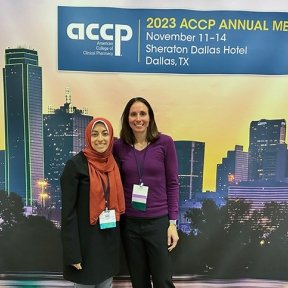
Sara Salama, Pharm.D., (2024 PGY2 Ambulatory Care Pharmacy Residency Graduate) and Christie Schumacher, Pharm.D., BCPS, BCACP, BCCP, BC-ADM, CDCES, FCCP (PGY2 Ambulatory Care Pharmacy Program Director) at the 2023 American College of Clinical Pharmacy (ACCP) Annual Meeting in Dallas, TX.
Liz Van Dril, Pharm.D., BCPS, BCACP, CDCES, 2018 PGY2 Ambulatory Care Pharmacy Residency Graduate
Liz Van Dril, Pharm.D., BCPS, BCACP, CDCES (2018 PGY2 Ambulatory Care Pharmacy Residency Graduate) and Christie Schumacher, Pharm.D., BCPS, BCACP, BCCP, BC-ADM, CDCES, FCCP (PGY2 Ambulatory Care Pharmacy Program Director) presented their research on the impact of professional continuous glucose monitoring by clinical pharmacists at the ACCP Global Conference on Clinical Pharmacy in Seattle, WA.
