CCOM Student Contributes to Parkinson’s Disease Research
Publication in npj Digital Medicine highlights hands-on clinical research experience
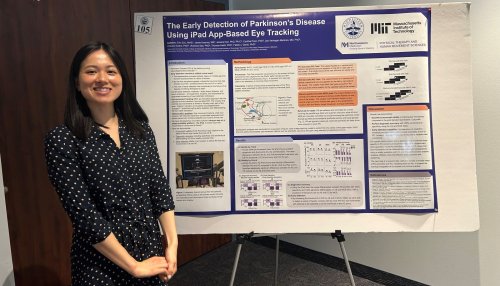
Erin Zou (CCOM ’27) presents research on detecting and monitoring Parkinson’s disease using an eye-tracking system at Midwestern University’s Kenneth A. Suarez Research Day on the Downers Grove Campus.
When Erin Zou (CCOM ’27) began looking for a summer research opportunity after her first year at Midwestern University’s Chicago College of Osteopathic Medicine, she hoped to find a project that combined her interests in neuroscience, patient care, and clinical research.
Less than two years later, she is a co-author on a study published in npj Digital Medicine, a Nature Portfolio journal, that explores a promising new approach to detecting and monitoring Parkinson’s disease using an iPad-based eye-tracking system.
Finding a Research Opportunity
The study was conducted through the Department of Physical Therapy and Human Movement Sciences at Northwestern University Feinberg School of Medicine, an interdisciplinary research group focused on movement disorders such as Parkinson’s disease, stroke, and related neurological conditions. Researchers evaluated whether a low-cost, portable eye-tracking system could accurately identify subtle differences in eye movements between patients with Parkinson’s disease and healthy individuals.
The findings demonstrated that the iPad-based system preserved clinically meaningful differences in eye movement measurements, supporting its potential as a scalable tool for screening and monitoring Parkinson’s disease.
The research builds on previous work validating a deep-learning-based iPad eye-tracking system against a clinical-grade eye tracker. In the latest study, researchers demonstrated that the tablet-based approach preserved clinically meaningful differences in eye movement measurements between patients with Parkinson's disease and healthy controls, supporting its potential as a scalable and cost-effective tool for screening and disease monitoring.
"These results are exciting because eye movement is a highly sensitive motor function, and subtle abnormalities may reveal early-stage neurological impairments in Parkinson’s disease and related disorders," Erin said. "The iPad-based approach is particularly promising because of its scalability and cost-efficiency, which could make it useful in home-based settings and help expand access to screening."
Contributing to Clinical Research
As a student researcher, Erin played a hands-on role in the project. She conducted one-hour eye-tracking sessions using both the gold-standard EyeLink 1000 Plus system and the iPad-based platform, recruited study participants through neurology clinics and Parkinson’s disease advocacy events, and collected primary data from approximately 30 participants. She also provided feedback on the development of the deep-learning algorithm used to distinguish patients with Parkinson’s disease from healthy controls.
Erin joined the research team in June 2024 after reaching out to laboratories whose work aligned with her interests in neurological disorders and patient-centered research.
"By the end of my first year, I knew I wanted to dedicate my summer to clinical research," she said. "As a former neuroscience major, I was particularly interested in studying neurological disorders and working directly with patients."
The project was mentored by Daniel Corcos, Ph.D., Fabian David, Ph.D., and collaborators at Northwestern University and the Massachusetts Institute of Technology. Erin credits the experience with deepening both her scientific knowledge and her appreciation for interdisciplinary collaboration.
"Through this project, I gained a deeper understanding of Parkinson’s disease, but I also found fulfillment working with patients who were enthusiastic about advancing research," she said. "I enjoyed collaborating with physicians, researchers, and software developers and hope to continue pursuing clinical research throughout my medical career."
The research experience also built upon skills developed at Midwestern University. Erin noted that coursework during her first year at CCOM provided a strong foundation in neurology and disease processes, while patient-centered experiences through the Community Health Clinic and Physical Exam Skills courses helped prepare her to work confidently with study participants.
Presenting and Publishing Research
In addition to publication in npj Digital Medicine, Erin presented related findings at Kenneth A. Suarez Research Day 2025, where the project received an Outstanding Poster Presentation Award, and at the American College of Osteopathic Surgeons Medical Student Section Spring Conference.
The publication highlights the growing role that student researchers can play in advancing healthcare innovation while gaining firsthand experience in clinical investigation and interdisciplinary collaboration.