Patient’s Story Offers Lessons for Future Physicians
CCOM students explore the challenges of diagnosing amyloidosis and the importance of listening to patients
- IL - Downers Grove
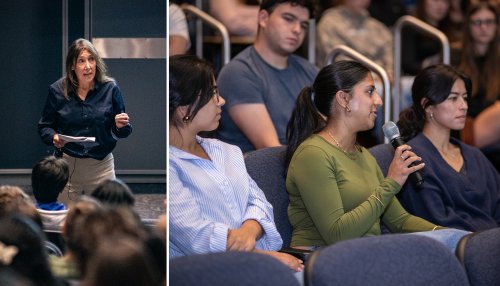
Patient educator Rhonda McGowan (left) shares her experience with amyloidosis, while Chicago College of Osteopathic Medicine students ask questions and gain firsthand insight into caring for patients with a complex disease.
Before medical students learn to recognize a rare disease in practice, they can learn something equally valuable from a person living with it.
For students at Midwestern University’s Chicago College of Osteopathic Medicine (CCOM), that opportunity came through a visit from Rhonda McGowan, a patient educator with the Amyloidosis Speakers Bureau. Her experience brought a personal perspective to a complex disease, helping connect medical knowledge with the people students will one day care for.
The presentation gave students an opportunity to hear about the patient’s journey through symptoms, diagnosis, treatment, and daily life. George Borrelli, D.O., Chair of the Department of Clinical Integration, moderated the session, which paired an educational video with McGowan’s story and time for questions.
Understanding a Difficult Diagnosis
Amyloidosis involves the buildup of abnormal protein deposits in the body’s tissues and organs. Different forms of the disease can affect different parts of the body, including the heart, kidneys, and nervous system. That complexity can make recognition difficult.
As future physicians, the topic offers an important lesson in approaching symptoms that may not immediately point to a clear answer. Patients may see multiple doctors before receiving a diagnosis, while their disease continues to progress.
Ms. McGowan lives with AL amyloidosis and had undergone CAR-T therapy earlier this year. Hearing from someone navigating the disease gave students a way to consider its impact beyond a description of symptoms or a discussion of treatment.
For Mackenzie Curry (CCOM ’29), the presentation offered a reminder to look beyond how frequently a disease occurs.
“Just because we are taught a disease is rare in occurrence, that does not mean that it is insignificant. There is still a patient behind that illness, a patient with a family, career, and so much more,” Mackenzie said.
“It is helpful to humbly listen to the perspective of someone who has experienced the good and the bad of the medical field. I hope that we were all able to learn from her and do our best not to repeat the same mistakes of those who were initially caring for her,” she added.
Learning from the Patient’s Perspective
The Amyloidosis Speakers Bureau brings patient educators into medical education to share those experiences directly with future healthcare professionals. The format creates space for conversations about matters that can be harder to capture in a textbook: uncertainty, self-advocacy, support, and the relationship between a patient and a physician.
“Amyloidosis is a condition I had never heard of before, so it was not only touching to hear Mrs. McGowan’s story but also a great learning experience,” said Edward Burke (CCOM ’30). “The major benefit for me as a first-year student hearing this story is to serve as a reminder that listening to the patient is often the most important characteristic to have as a future doctor.”
The experience also connected classroom learning with the challenge of considering a less familiar diagnosis. Recognizing a rare condition requires knowledge, attention to a patient’s history, and a willingness to keep asking questions when the explanation remains unclear. These are all skills CCOM students are learning during their time at Midwestern University.
“I hope that, even as the demands of medical training continue to grow, I never lose sight of the person behind the diagnosis and the importance of taking the time to truly hear their story,” Edward added.