Putting the Science in Science-Fiction: Midwestern Hosts Booth at Phoenix Fan Fusion
Students, faculty, and staff taught anatomy of predators and prey, debunked creatures from cinema, and ignited passion for scientific inquiry
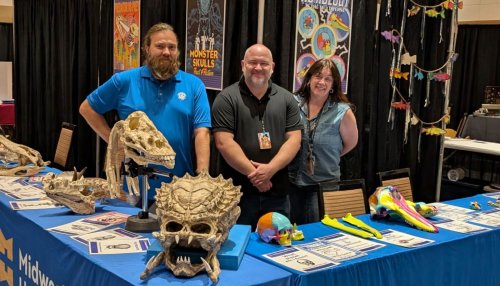
The Anatomy Department at Midwestern University’s Glendale Campus hosted its first booth at Phoenix Fan Fusion, an annual pop-culture convention for fans of comics and sci-fi movies, books, and television. The three-day event was held on June 5th-7th and drew thousands of community members.
The booth featured both real and 3D-printed anatomical skulls for guests to guess which were predators and which were prey. Visitors might also have been surprised to see a few “monster” skulls among the real ones, from the movies Star Wars and Predator.
Debunking Movie Monsters
Beth Townsend, Ph.D., Professor of Anatomy at Midwestern, led the two-month project of creating, assembling, and painting the model skulls. She and Justin Georgi, Ph.D., Professor of Anatomy, did an anatomical breakdown of the two fictional skulls, debunking the creatures’ ability to exist in real life.
For example, the fictional monster in Predator is a voracious carnivore, but Dr. Townsend explained that “it lacks the attachment sites for the jaw musculature needed to eat meat.” She continued, “It also has a nasal cavity so tiny that it wouldn’t be able to breathe as it’s chasing down its next meal. We were able to compare it to the real lion skull at the booth, which has a huge nasal cavity that allows it to run after its prey.”
The other movie creature skull they created and debunked was a Gungan, Jar Jar Binks’s species in Star Wars. Dr. Townsend explained that the Gungan is supposed to be made entirely of cartilage, much like a shark. However, sharks have one part – the jaw – that’s made of bone rather than cartilage. With a bone jaw, a shark effectively transfers the force of the bite back into its prey. A fully cartilaginous creature like Jar Jar Binks would lack the force needed to chomp the hard-shelled mollusks he’s seen eating in the films.
The booth also featured the mythical-sounding Dracorex hogwartsia (meaning “Dragon King of Hogwarts”). This real fossil skull is covered in spikes and looks like something you’d read about in Harry Potter. However, Dr. Townsend said “it was later discovered to be a juvenile form of the Pachycephalosaurus dinosaur, so that species name is no longer valid. But it’s still fun to show!”
The Impact of Community Outreach
There were an estimated 4,000 visitors that interacted with students and faculty at the University’s booth at Phoenix Fan Fusion, with conversations spanning from the anatomy of the skulls displayed to the various programs offered at Midwestern.
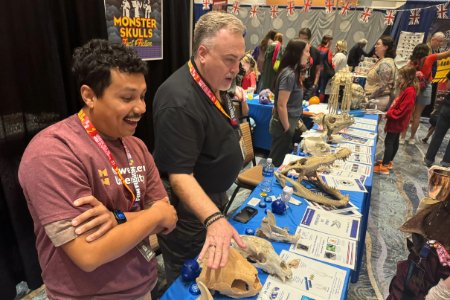
“The best science outreach shows people that science isn’t abstract, isolated, and beyond their reach. It’s everywhere and can be a part of everything they do,” said Dr. Georgi. “I love seeing people realize how fun scientific inquiry can be. An instant connection forms because they see how much we enjoy this and they realize they think it’s cool too!”
Dr. Georgi also noted that “scientific outreach is always as valuable for the scientist as it is for the public. Communicating your ideas, keeping them interesting, and connecting them to others knowledge is something every research scientist should practice as often as possible.”
Twenty students from the Arizona College of Osteopathic Medicine and the College of Veterinary Medicine got the opportunity to practice that scientific communication while they volunteered at the booth.
“I loved talking with people and seeing how making science fun and interactive sparks interest in kids and adults alike,” shared Erin Donahue (AZCVM ’29), a veterinary student at Midwestern.
Dr. Townsend summarized that “doing outreach helps energize our research. It reminds us to change our perspective, make new connections, and remember that the public likes science!”
Learn more about the Arizona Research Collection for Integrative Vertebrate Education and Study (ARCIVES) at Midwestern University.