When Art Fights Superbugs: Raising Awareness of Antimicrobial Resistance
Midwestern University pharmacists lead a creative initiative to help the public understand antimicrobial resistance
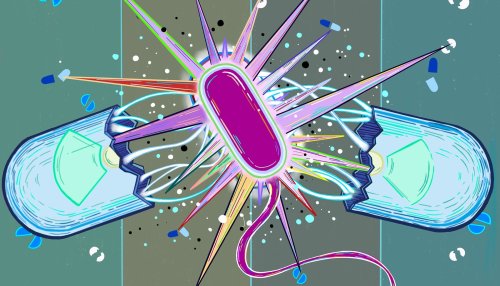
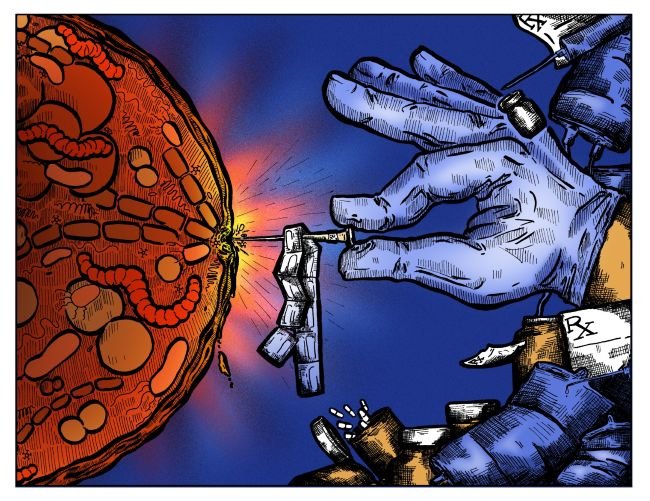
Created for a public awareness initiative led by Midwestern University pharmacists, Superbug by Indra Mungunsuh won first place in the antimicrobial resistance art competition.
Imagine getting a simple infection and realizing the medicine that should help doesn’t work. Antibiotics changed the way we fight disease, turning once-deadly infections into treatable ones. But when they fail, even everyday illnesses can become serious, and routine medical procedures can carry new risks.
Two faculty members at Midwestern University’s College of Pharmacy, Downers Grove (CPDG) are using an unexpected tool to help people understand that growing threat: art.
Infectious diseases pharmacists Sheila K. Wang, Pharm.D., BCIDP, Professor, Pharmacy Practice, and Radhika S. Polisetty, Pharm.D., FIDSA, BCIDP, Professor, Pharmacy Practice, are leading a collaborative project that invites Chicago artists to visually interpret antimicrobial resistance (AMR), the process by which bacteria evolve to survive the drugs designed to kill them
Supported by an educational grant from the Society of Infectious Diseases Pharmacists, the initiative aims to translate a complex global health challenge into powerful images that resonate with the public. The project brings together faculty at Midwestern University and collaborators at Northwestern Medicine to raise awareness about antimicrobial resistance.
Finalists for the art competition were announced on March 13, 2026. Indra Mungunsuh earned first place for the piece Superbug. Second place was a tie, with Sidney Abbott recognized for Cost of Control and Joaquin Torres-Morales for Popping the Bubble. The winning works will be displayed in a traveling gallery and potentially across public spaces in Chicago.
According to Dr. Wang, the idea began with a simple goal of bringing the conversation about antimicrobial resistance to the public.
“For us, getting the general public to understand AMR was our most important goal,” Dr. Wang said. “Within the healthcare system we have awareness, but we wanted to reach the people who are just walking around Chicago who might not know that you shouldn’t use an antibiotic for a viral infection or a cough and cold.”
Inspired by the city’s murals, transit graphics, and public art installations, Dr. Wang wondered whether similar visual storytelling could help communicate an urgent health issue. “I look at the artwork around Chicago — on buses, trains, construction sites — and thought, why can’t we do that too to help share this message?” she said.
Why Antimicrobial Resistance Is Hard to Explain
Communicating the importance of antimicrobial stewardship to the public can be challenging because the problem is largely invisible, Dr. Polisetty explained.
“People think it’s a problem that will happen far in the future,” she said. “If you talk about resistance, sometimes their eyes glaze over because they’re sick now and they want to feel better now.”
But the consequences are already being felt in hospitals, where clinicians sometimes encounter infections with limited treatment options. “We are seeing patients where we don’t have good options anymore,” Dr. Polisetty said. “Unless people know someone affected by it, they often don’t realize how urgent the issue is.”
A One Health Approach
Antimicrobial resistance doesn’t exist in humans alone. Resistant bacteria can move through meat, produce, and even water sources. Improper disposal of antibiotics or untreated waste can introduce these organisms into soil and waterways, creating a cycle that is difficult to break.
This is where the concept of One Health comes in, highlighting the connections between people, food-producing animals, and the broader ecosystem.
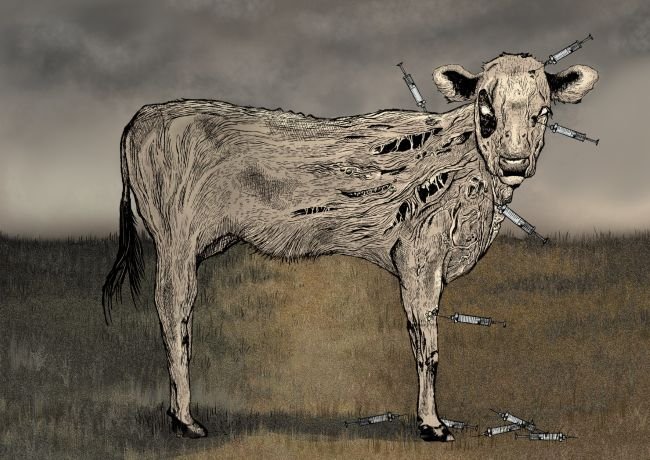
“Bacteria don’t respect boundaries,” Dr. Polisetty explained. “Antibiotics used in livestock can contribute to resistant strains that end up in our food or the environment, and eventually can reach humans.”
A Universal Language
By illustrating antimicrobial resistance through art, the project also aims to show that AMR is a community problem. Awareness of how human, animal, and environmental health are linked is critical for making smarter choices, from prescribing practices to food consumption and waste management.
The project partnered with students at Columbia College Chicago, who submitted original art inspired by antimicrobial resistance. Organizers provided background information and collaborated with the art students to refine their submissions.
“Art is something that is universal. It speaks to everyone and it doesn’t require any particular education level,” Dr. Polisetty said. “Anyone walking down the street should be able to look at it, interpret it, and get something from it.”
Now that the finalists have been selected, the artwork will be displayed in a traveling gallery beginning at Columbia College Chicago and potentially at locations including hospitals, libraries, Midwestern University, and other universities. The team is also exploring opportunities to place select pieces in public transit spaces, where everyday commuters could encounter the artwork. Each piece will include a QR code linking viewers to educational resources about antimicrobial resistance.
Pharmacists on the Front Lines
The initiative also highlights the critical role infectious diseases pharmacists play in antimicrobial stewardship programs within hospitals.
“Across the country, the majority of antimicrobial stewardship programs are operationally led by infectious diseases pharmacists,” Dr. Wang said. “Our job is to make sure antibiotics are used appropriately and consistently across healthcare systems.”
Dr. Polisetty added that many people are unaware that pharmacists specialize in infectious diseases and lead much of the research and operational work in antimicrobial stewardship.
“When people think of pharmacy, they often think of a retail pharmacist,” she said. “But clinical pharmacists are deeply involved in patient care, research, and programs that help protect the effectiveness of antibiotics.”
For both faculty members, the art initiative represents a new way to expand that work beyond hospital walls.
“This is really about starting a grassroots effort,” Dr. Wang said. “If we can keep building awareness year after year, people may begin to recognize the message and understand why antibiotic stewardship matters.”