Conversation on Dental Excellence: College of Dental Medicine-AZ Dean Shares Takeaways from Dental Education Summit
Dental school deans gathered at the Reimagining Dental Education summit to advance dental education
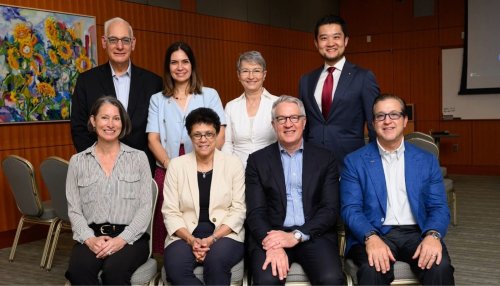
Front, from left to right: Sheri Brownstein, Carol Ann Trotman, William V. Giannobile, Richard Rosato
Back, from left to right: Frank Lacari, Marcia Campos, Geralyn Crain, and David Wu
Sheri Brownstein, D.M.D., Dean of the College of Dental Medicine at Midwestern University, joined dental educators from across the United States, Canada, and the United Kingdom at the Reimaging Dental Education Summit at Harvard School of Dental Medicine this summer. The 3-day summit focused on enhancing dental education and making oral care more accessible for communities. The collaboration occurred through working groups, with each group addressing a current topic impacting oral health and education.
Dr. Brownstein shared her insights on the Summit:
What new perspectives are you bringing back to Midwestern University after the Summit? How do collaboration and interaction with other leaders elevate the profession?
One of the greatest benefits of attending a leadership summit is the opportunity to learn from colleagues across the country. While all dental schools are guided by the same accreditation standards, each institution brings unique experiences, innovations, and approaches to achieving those goals. Engaging with leaders from diverse academic and clinical environments broadens our perspective and helps us identify new strategies that can strengthen our own programs.
My working group, Technology & Practice Transformation, focused on the integration of artificial intelligence and emerging technologies in dental education and clinical practice, as well as preparing students for a rapidly evolving healthcare landscape. These discussions reinforced the importance of helping both faculty and students develop the skills needed to use these tools effectively, responsibly, and ethically. I am returning with valuable ideas for advancing AI literacy, fostering appropriate technology adoption, and ensuring our graduates are prepared to lead in a profession undergoing significant transformation.
The Reimagining Dental Education Summit focused on several challenges dental professionals face today, including workforce shortages, emerging technologies, and gaps in oral health accessibility. How are students at Midwestern University prepared to address today’s healthcare challenges?
Midwestern University is uniquely positioned to prepare future dentists for the challenges facing healthcare today. We are fortunate to have a leadership team that has long recognized the importance of innovation, service, and community engagement. Since its inception, the College of Dental Medicine–Arizona (CDMA) has been a leader in integrating educational and clinical technologies, and our new president Dr. Baker's vision for MWU 2035 continues to support initiatives that advance both student learning and patient care.
One of the most persistent challenges in oral healthcare is access to care. Interestingly, many of the leadership summit readings, spanning more than a century of dental literature, highlighted the same issues we continue to face today, particularly oral health accessibility. At CDMA, we embrace a dual mission: providing an exceptional education for our students while serving as an essential oral healthcare safety net for our community.
What actions has the College of Dental Medicine-Arizona implemented to achieve the commitment of providing oral healthcare to the community?
This commitment begins in the first year, when students receive foundational instruction in multicultural healthcare, human behavior, and patient-centered care. During their second year, students participate in community service courses that take them into special needs schools, where they provide oral health and nutrition education directly to community members.
Our commitment to access extends beyond education. Through the Patient Financial Assistance Program, eligible patients may receive reductions in fees, with some receiving care at no cost. The Dental Institute also hosts quarterly Community Dental Days, partnering with organizations such as The Dream Center and John Volken Academy to provide comprehensive dental care for underserved populations. Patients who enter the system through these events become comprehensive care patients and can continue receiving treatment at no cost.
What is the value of these community outreach opportunities for the students?
These experiences are invaluable for students. They gain firsthand experience caring for individuals from diverse backgrounds while learning the importance of compassion, empathy, and cultural sensitivity. Prior to experiences, students receive education in trauma-informed care, preparing them to effectively serve patients who may have experienced physical, emotional, or social challenges.
Under the leadership of Dr. Cara Copeland, Director of Community Service and Outreach, CDMA participates in more than 30 outreach events annually, including health fairs, school-based education programs, career exploration activities, mentoring initiatives, and community service projects. These experiences help students develop not only clinical competencies but also the communication, leadership, and service-oriented mindset needed to address today's healthcare challenges and improve oral health outcomes in the communities they serve.
A priority of the summit was to “break down silos to improve health.” What collaboration is happening on campus to reach across those silos, and what do you hope to see implemented moving forward?
Another important challenge highlighted during the summit was the need for greater integration between medicine and dentistry. At Midwestern University, this philosophy is embodied through our One Health Initiative, which recognizes that optimal health outcomes are achieved when healthcare professionals collaborate across disciplines.
The College of Dental Medicine–Arizona actively partners with other Midwestern University colleges through research, education, and community outreach. Recent examples include a collaboration between CDMA and the Arizona College of Optometry at the Backpack Buddies event, where students worked to provide oral health and vision screenings for 2,000 schoolchildren. Additionally, every first-year dental student receives a vision screening conducted by optometry students, reinforcing the value of interdisciplinary care from the start of their professional education.
Interprofessional learning opportunities also continue to expand across campus. Faculty and students from CDMA, the College of Pharmacy-Glendale, and the Arizona College of Osteopathic Medicine have participated in interprofessional elective courses designed to foster collaboration and team-based healthcare. For more than five years, CDMA and the Physical Therapy Program have partnered to provide instruction in dental ergonomics, helping students develop healthy clinical practices that support long-term career wellness. This fall, the Dental Institute will further strengthen interdisciplinary learning by hosting pharmacy students as part of their clinical rotation experiences.
Looking ahead, I hope to see even more opportunities for students and faculty from different healthcare disciplines to learn, serve, and solve problems together. As healthcare becomes increasingly complex, the ability to collaborate across professions will be essential. By continuing to break down traditional silos, we can better prepare our students to deliver comprehensive, patient-centered care and improve health outcomes for the communities we serve.
Learn more about the College of Dental Medicine-Arizona and the Dental Institute at Midwestern University.