Medical Students Advocate for Fair Reimbursement and Residency Growth in Springfield
CCOM delegation participates in Illinois Osteopathic Advocacy Day
- IL - Downers Grove
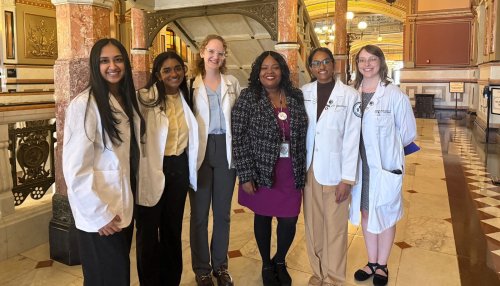
CCOM students participated in the Illinois Osteopathic Advocacy Day in Springfield. From left: Chandni Chandiramani, Vani Ganesh, Faith Harvey, Senator Lakesia Collins (5th District), Raashmi Krishnasamy, and Dr. Amanda Krus-Johnston.
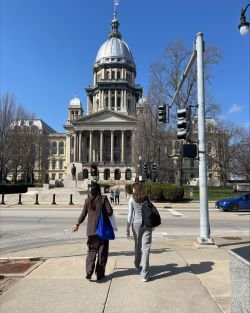
Medical students from Midwestern University’s Chicago College of Osteopathic Medicine (CCOM) traveled to Springfield on March 10th to advocate for two pressing healthcare priorities. They focused on protecting physicians from insurance downcoding and strengthening Illinois’ physician workforce through expanded residency training.
Participating in Illinois Osteopathic Advocacy Day, coordinated by the Illinois Osteopathic Medical Society, the CCOM students met directly with legislators. They advocated for Senate Bill 3114 and House Bill 4735 to prevent insurers from automatically downcoding claims, as well as Senate Bill 2817 to expand the state’s Medical Residency Grant Program.
“We advocated for two key healthcare issues at the state capital,” said Anisa Ciaciura (CCOM ’29). “The first addressed downcoding to prevent insurers from automatically reducing claims and ensure fair reimbursement for the care physicians provide.”
Downcoding occurs when insurers reassign a claim to a lower-level billing code, often through algorithm-based reviews without physician oversight. The proposed legislation would prohibit automatic downcoding, require physician involvement in claims review, and improve transparency through clear clinical rationale and accessible appeals processes.
“The second issue focused on strengthening the physician workforce” Anisa added, “encouraging lawmakers to support Senate Bill 2817, which would expand residency training opportunities and help address the growing physician shortage in Illinois.”
According to the Illinois Osteopathic Medical Society, Illinois faces a significant physician shortage, with many communities designated as health professional shortage areas and a large share of the workforce nearing retirement. Limited residency positions force many graduates to train and eventually practice out of state. Senate Bill 2817 would expand residency slots and support new programs to improve access to care, particularly in rural and underserved areas.
A broader view of patient care
For CCOM students, the day’s conversations highlighted that patient care extends far beyond the clinical setting. “Advocacy day in Springfield reminded me that becoming a good physician means advocating not only for the patients in front of you, but also for the policies that shape their care,” said Arianna Halani (CCOM ’28), who helped organize CCOM’s delegation. “This experience will help me become a better physician by showing me how important it is to have a voice beyond the exam room.”
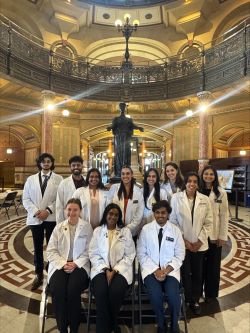
Other members of CCOM’s SGA IOMS Committee, Anisa Ciaciura (CCOM ’29), Anokhee Desai (CCOM ’28), and Anish Kakarla (CCOM ’29), helped organize the event with the assistance of Illinois Osteopathic Medical Society and fellow osteopathic medicine students and residents.
For many students, the most meaningful part was connecting their personal training experiences to policy discussions.
“Advocacy becomes much more meaningful when we bring our personal experiences into the conversation,” Anisa said. “As medical students, we have a unique perspective on how the two bills discussed affect our training, careers, and future patient panels; sharing those stories helps lawmakers better understand the real-world impact of their decisions.”
Chandni Chandiramani (CCOM ’28) emphasized that advocacy is a long-term investment in both patient care and professional practice. “Advocacy is an essential skill for physicians and learning how to practice it as a medical student prepares us to better serve our patients and communities in the future,” Chandni said. “Since policies often take years to develop and implement, the advocacy efforts we pursue today will help shape the conditions and opportunities of our future careers.”
Understanding how change happens
The experience also offered insight into the policymaking process itself.
“Participating in advocacy days allows medical students to see how healthcare decisions are made behind the scenes,” said Abigail Anderson (CCOM ’28). “If we want to strengthen and improve our field, we need to start practicing how to advocate for our patients and our profession…skills that will remain important throughout our careers.”
Her classmate agreed. “Having the opportunity to engage with Illinois government officials and advocate for meaningful change this early in our careers is incredibly rewarding,” added Anokhee, “especially knowing these efforts can directly impact the health of our future patients.”
Organizers hope to expand participation in future years, building on the strong turnout and engagement from this year’s delegation. Some CCOM students will continue their advocacy efforts later this month at DO Day on the Hill in Washington, D.C.
CCOM Student Participants
- Asraar Ahmed (CCOM ’28)
- Abigail Anderson (CCOM ’28)
- Anisa Ciaciura (CCOM ’29)
- Chandni Chandiramani (CCOM ’28)
- Anokhee Desai (CCOM ’28)
- Vani Ganesh (CCOM ’27)
- Arianna Halani (CCOM ’28)
- Anish Kakarla (CCOM ’29)
- Kristina Mallabo (CCOM ’29)
- Naomi Rajesh (CCOM ’28)
- Shreyas Rajagopalan (CCOM ’28)